Showing posts with label spoilers. Show all posts

Wednesday, March 4, 2020

THE SONG OF NAMES


Directed by Francois Girard and starring Tim Roth as Martin, Clive Owen as David Rapoport. Based on the novel by Norman Lebrecht.

THE SONG OF NAMES has lured me back into the movie theaters, after a period of absence through indifference to a recent string of forgettable titles. And for me it was a welcome return. Here is a movie that is about something. It is about friendship, identity, and betrayal. More importantly, it is about the power of music—the power of a song to remember and memorialize life and loss.

The abrupt disappearance in 1951 of young violin virtuoso, David Rapoport, moments before his London concert debut, precipitates a 35-year search by his boyhood friend, Martin. The motives behind Martin’s quest are complicated: Not only is he trying to solve a mystery, but he wants to avenge a tragedy: David’s desertion of the concert was a betrayal of Martin’s father, who had sponsored the concert at great cost, and who subsequently had died of a heart attack.

This information comes to us only gradually, by fits and starts, through a series of flashbacks, while Martin spends decades relentlessly tracking David’s course from London to Warsaw to America and back to London.

The flashbacks reveal that the two friends had first met in 1939 when David’s father entrusted his ten-year old violin prodigy to Martin’s family before taking his family back to Poland. The two boys conquered their initial hostility and bonded in friendship during to the London Blitz and beyond. It is only when, shortly after the war, David learns, almost by accident, of the fate of his family during the Holocaust, that he abruptly deserts the London concert, regains the Jewish identity that he had abjured, and embarks on an odyssey of his own that eventually takes him to Treblinka, the site of the deaths of his family and millions of other Jews. There, amidst the grave markers, he again takes up his violin and plays a song—
the song of the movie’s title—the song whose melody he has composed to a text comprised of the names of the Jewish dead.
Martin knows nothing of this when he finally catches up with David, now living quietly in a Jewish faith community in London. A phenomenally gifted violinist, he no longer pursues a concert career. He performs music exclusively in the service of this faith. Martin’s anger at David quickly turns to sympathy. But not before he demands that David finally redeem the tragedy that befell his family and perform the concert that he had abandoned thirty-five years ago.

This time David shows up. He performs Max Bruch’s First Violin Concerto. Then, unexpectedly, after the intermission, instead of playing music by Bach, he reappears garbed in traditional Jewish cloths and plays the music he had composed for his “Song of Names.”

Then, true to form—he disappears. Again.

The letter he leaves behind is an apology to Martin for the pain his past actions had caused his family. He wants only to turn his back on a selfish life of personal gain and return to his faith community.

But there’s more. It turns out David has more than his desertion of Martin’s family to atone for: There’s the mystery of his actions immediately prior to that concert of long ago. It’s a mystery that only Martin’s wife can solve: She confesses: Martin had been with her.

Martin says nothing. But he turns inward and, in the dark, silently recites Kaddish for the friendship that once was.

This is only one among many wonderful set pieces of the film. There is an impromptu violin duo of Paganini’s music between David and another boy while huddling in a London bomb shelter. In another scene, David stands alone in long shot performing his Song of Names in a Triblinka memorial site. And there’s the key sequence of the film, when David first visits a London Jewish community and hears the Rabbi chanting the music and the names of his own family, victims of Treblinka. The collective impact of these musics and these names is overwhelming.

Tuesday, March 3, 2020

PORTRAIT OF A LADY ON FIRE


Written and directed by Celine Sciamma and starring Noemie Merland as Marianne and Adele Haenel as Heloise.

“Do all lovers feel they are inventing something?”

The question hovers over two women who indeed are inventing something—not just creating their mutual love but telling a story about it.

Which also describes what writer-director Celine Sciamma is doing in the acclaimed French film, PORTRAIT OF A LADY ON FIRE. She inscribes on the screen a series of deft images, that coalesce into an unusual love story, a process not unlike the painter named Marianne whose brush strokes on canvas gradually reveal a portrait of the woman who will become her lover.

Marianne has come to the wild coast of Brittany on a commission to paint a portrait of young Heloise. In this world of mid-18th-century France, a woman’s portrait introduces her to the hitherto unknown man she has been obliged to marry. Thus, we can understand why Heloise is reluctant to sit for the portrait which, in effect, will seal her doom. What results is a miracle that nothing to do with the arranged marriage: While Marianne studies the face and form of her subject, Heloise all the time is looking back at her—in effect, painting Marianne’s portrait. Call this a dual portrait. Call it a collaboration.

Which brings us to the central conceit of the movie—the relationship between Marianne the artist and Heloise her lover is compared to the Greek myth of the poet Orpheus and his great love, Eurydice. According to the myth, Orpheus descends into the Underworld to retrieve his lost love, Eurydice. With the power of his words (the song) and his music (the lyre), he persuades Hades to release Eurydice to the upper world. But there is a catch: During the ascent, Orpheus is forbidden to look back at her. However, pausing on the threshold, torn in a moment of doubt, he does look back. And loses Euridice. Moreover, Orpheus himself is forbidden to return and he is slain.

What is the meaning of this story? The Romantic philosophers, for whom this myth is a key text, suggest that while Orpheus yearns for ideal love, he is ultimately trapped by the impossibility of his dream, claimed by the pragmatic reality of the everyday world. This is called THE ROMANTIC IRONY: The true Romantic never attains—or even deep down never wants to attain—that higher realm that he’s yearning for.

Heloise offers her own interpretation as to why Orpheus looks back at Euridice: “Maybe Euridice asked him to.” It’s a startling insight. It is Euridice, not Orpheus, who seals the lovers’ doom. Let’s consider this in terms of this movie: When Heloise returns Marianne’s gaze, their fates are sealed. Like Orpheus and Euridice, they are fated never to be together. While Marianne loses Heloise, Heloise must live on elsewhere in an arranged and loveless marriage. Both are condemned to an emotional limbo.

This brings the film to a beautiful, yet tragic conclusion.

So far so good.

But I have a problem with all of this. It involves the music on the soundtrack. Early in the story, Heloise tentatively pick out a few notes of a melody on the piano. This is music, she says, that burns in her memory, something she had heard once before. And it is this music that wells up on the soundtrack—the only moment in the film when orchestral music is heard— during the final scene in an opera house as Heloise, now a married mother, looks back, in effect, and laments the lost love for the absent Marianne. We might expect this music of memory to be the most famous music ever composed to evoke the Orpheus myth—Gluck’s “Dance of the Furies” from his opera, Orfeo and Eurydice. But instead, to my shock and disappointment, what we hear instead is the “Summer” section of Vivaldi’s The Seasons! While this music in its violence bears a fleeting resemblance to the Gluck, it is not the Gluck. Director Celine Sciamma must have her reasons for this unfortunate substitution, but for the likes of me, it seems that she is evading the core myth she has been at such pains to create.

Now, go ahead and blame me for committing the cardinal sin of movie criticism—rewriting the movie.


Friday, October 25, 2019

THE LIGHTHOUSE


Written and directed by Robert Eggers. Starring Robert Pattinson and Willem Dafoe.

LAND’S END

SPOILER ALERT!

I like THE LIGHTHOUSE, although it is an unlikeable film.

Young Ephraim Winslow (Pattinson) has just come to a remote and windswept lighthouse to assist the grizzled old lighthouse keeper (Dafoe) in his daily chores. There’s thunder in the air. Seagulls daily assault the property. Mermaids disport themselves on the rocks.

And the lighthouse rears up against the tumbling clouds, its circling eye piercing the gloom, endlessly searching... perpetually warning...

THE LIGHTHOUSE is as grim and uncomfortable as it gets. Not just for the two men trapped in its stony entrails but for the viewer, likewise confined to his theater seat, reluctantly unable to look away. We’re all confined. And we get a sense of what’s in store when young Winslow smashes an offending sea bird against the rocks. Disaster will follow, warns his boss. The reference to Coleridge’s “Rime of the Ancient Mariner,” where all hell breaks looks due to the destruction of an albatross, is not accidental; indeed, the dark spirits of other masters of the grim maritime guignol, Edgar Allan Poe and William Hope Hodgson, are constantly evoked. Nightmares and monsters are coming to call.

Take these two men, inexperienced apprentice and grizzled old veteran, lock them into the lighthouse, shake rather than stir, and watch what happens. What begins as a sedately paced account of the daily chores of a lighthouse—hauling the coal up the cliffs, cleaning the cistern, scrubbing the walls inside and out—slowly turns nasty. Storms arrive and repel passing ships. Food supplies diminish. The water goes foul. The two men exchange their good-natured “Yo-yo-ho, and a bottle of rum” sea shanties for insults and knotted fists.

The lighthouse, meanwhile, is hungry. Its platforms, circular stairs, and revolving gears are the teeth and jaws waiting to crunch the men’s bones and swallow their blood. You could typify the entirety of THE LIGHTHOUSE as a deadly case of indigestion.

And pay attention, because as things get worse, master and apprentice seem to exchange identities. Who, now, is who? “Curiouser and curiouser,” said Alice.

And in the end, the lighthouse swallows and spits up on the rocks our young lighthouse apprentice. The sea birds feed on his corpse and tug at this liver. Prometheus is bound.

And we viewers, in the end, are lost, without a lighthouse to guide us home.

Saturday, October 5, 2019

JOKER


Directed by Todd Phillips. Starring Joaquin Phoenix.

Gotham City has a sound. It’s the grind of several double-bass instruments flailing away in the basement of their registers. And Gotham City has a laugh, a high, maniacal laugh emitted from the throat of a psychopathic killer named Arthur Fleck. In case his name is not familiar, try... Joker.

And Gotham City has a theme. It’s a street sermon delivered with a sledge hammer about the ills of our cities and our citizens—that we are all mad; and that we are all jokers. In case that’s not abundantly clear by the end of the film, we have this amazing scene where the city erupts in flame and riot, and the streets are clogged with jokers, every one of them wearing clown masks. And one of them levels a pistol and shoots the city’s mayor and his wife at point-blank range.

And here’s the irony—we don’t know who that killer is. Is he the Joker? He could be any one of all the jokers (lower case) in the world. To compound the irony, the real Joker makes his escape by clapping on a clown mask over his own hideously clownish face makeup. Double jeopardy.

I think this movie is already in trouble. At least that was the muttered verdict overheard from departing viewers. That grind and that laugh is just too much. Joaquin Phoenix, who is already something of a “joker” in his predilection for bizarre roles, pulls out all the stops, relentlessly laughing until he chokes, tugging up the corners of his mouth at every opportunity, and dancing and capering down streets abd alleyways.

Must we have backstories for all our super heroes and villains? Must we explain away Joker’s sublime villainy with lurid tales of child abuse, a medical condition that produces uncontrolled laughter (it’s called “pseudobulbar”), and so much psychobabble? He emerges before us as just another sick dude. But one with a red nose and green hair.

At least some viewers will have fun registering all the references the movie makes to other movies likewise famous for their bleak, nihilistic tone—like Billy Wilder’s Ace in the Hole on a theater marquee and references to Martin Scorsese’s King of Comedy and Taxi Driver. And all the while, when we’re not listening to the grinding away on those double-bass instruments, we’re hearing soundtrack songs like “That’s Life” and “Smile” (written by another clown, Charlie Chaplin).

And so, at the end, we leave Bruce Wayne, a victim of Joker, standing alone, his slain parents dead at his feet. He now will join the Joker as just another traumatized child with a flair for costumes.

Prologue: A psychiatrist sits opposite a manacled Joker, now incarcerated in the Arkham Asylum. “Tell me a joke,” she mutters. Joker looks up, then whispers, “You won’t get it.”

Will you?

Friday, August 16, 2019

ONCE UPON A TIME... IN HOLLYWOOD


SPOILER ALERT!

By now we must know that the new Tarantino film concludes by side-stepping the Manson-Tate murders and locating the crimes elsewhere. In other words, there is no Manson-Tate slaughter at all! We should be accustomed by now to the way Hollywood cherry-picks history, but this recent example is particularly startling. Its effrontery in altering history is rivaled, in my opinion, by the amazing conclusion to a mid-50s movie, QUANTRILL AND HIS RAIDERS: In this version of the Lawrence Raid, Quantrill and a few raiders are turned away at the city border and Quantrill is shot and killed by the citizenry.

In other words, there was no Quantrill/Lawrence Massacre at all!

Kinda takes your breath away, doesn't it?

I recall the advisories of cultural historians Hayden White and Niall Ferguson who propose that alterations in the historical time line should bear a certain responsibility. In other words, are the alterations executed in the realm of PROBABILITY? COULD they have happened that way? We could argue whether or not Tarantino obeys that injunction.

But this is Tarantino's thing, isn't it? When we see Hitler killed in INGLORIOUS BASTERDS, we know what he's up to.

I guess we have to respect these alternative histories... but it’s just a pity that films like these aren't accompanied by "teaching moments," that is, a sober examination of the whys and wherefores of these alterations. And excellent teaching moments they can be--the same holds true for Hollywood's alterations of the texts of stories and novels-- but, alas, are seldom observed. But that's a matter primarily for the classroom, right?

Thursday, January 24, 2019

THE KINDERGARTEN TEACHER.

Directed by Sara Colangelo. Starring Maggie Gyllanhaal.


HOMEWORK AFTER HOURS
I must confess a film with a title like THE KINDERGARTEN TEACHER might not have attracted me had it not been for the presence of Maggie Gyllanhaal. Since she is known for her brave performances in rather eccentric roles, so I gave this a look.

The rewards, for me at least, were many—not the least of which is her performance of a woman’s descent into madness... Never has a destructive obsession been so quietly, even tenderly observed.

At first, we see Lisa Spinelli as a quiet and caring teacher, patiently teaching her young charges their alphabets, playing them classical music during rest periods, and always attentive to their playground games. One day she overhears young five-year old Jimmy (Parker Sevak) reciting words that seem to be some kind of poem. She writes the words down. They are disarming in their unselfconscious simplicity. While Lisa is not a poet herself—her poor attempts in a night class she is taking elicit only polite interest from her teacher—she is sensitive enough to realize she has a young, even precocious talent on her hands.

Lisa decides to recite those lines to her night class. The praise from teacher and students is immediate and enthusiastic. Gratified, she claims them as her own. Eagerly, she waits for the little boy to produce another set of lines. Again, she writes them down, and again she recites them to the applause of her writing class.

She begins taking the little boy out of the classroom at times, into the bathroom, out to the playground, in search of a quiet space where he can tell her more of his poems. She never raises her voice. She is always quiet and tender. But it is obvious she needs something from him. And it is apparent that her mentoring is becoming manipulative. She is, in short, dangerous. She contacts his parents, pressing them to encourage his talent. Too often, she says, the world stamps out such promise. Jimmy is like a young Mozart, who must be allowed to realize his gifts. She is right about that, of course. But she decides she is the one to nurture him. At all costs.

Things are going downhill with Lisa. Soon, she is calling Jimmy at home on the telephone. When her writing teacher finds out she has been passing the boy’s poems off as her own, he throws her out of the class. He attacks her for exploiting and preying off the work of others. The boy’s father grows alarmed and transfers him to another school. At home, Lisa’s family life is unraveling. They care nothing about the arts, she declares; they are only pathetic and common...

Packing her bags one day, she slips out of the house and follows Jimmy to the playground of his new school. Crouching outside the fence, she entices him to leave with her for a trip. Where are they going? He asks. She drives on.

We watch, considerably alarmed, as she takes him swimming into a nearby lake. She hugs him to herself as he bobs up and down in the breakers. She takes him to a hotel. She tells him they will go away together and publish a book of his poems. The boy, who has passively accepted all this, now realizes something is very wrong. He locks her into the bathroom and calls the police. From the other side of the locked door, Lisa is resigned to her defeat. She calmly issues instructions to help him call the police and give them their address. It’s as if she is watching herself doing all this, complicit in it, only mildly alarmed at her own behavior. There are no rants, no attacks. She is just a sad, sad woman, eyes hidden behind sunglasses, a hint of a bewildered smile on her lips. Out of her obsession to protect and nurture—all of it supposedly out of her passion for Art—she is destroyed and perhaps so is the boy.

The final scene is devastating. The police arrive. The boy is taken to the car and locked in. From inside, we hear his still, small voice: “I have a poem,” he says. “I have a poem.”

But now there is no one to hear him. No one to listen. His fragile genius will surely wither away in an indifferent world. Lisa has been right all along. But she is lost in the darkness of the final fade-out.

Monday, November 12, 2018

HALLOWEEN


HALLOWEEN, directed by David Gordon Green, and starring Jamie Lee Curtis as Laurie Strode, Haluk Bilginer as Dr. Sartain, Will Patton as Officer Hawkins.

HIDE AND SEEK

You come away from the new HALLOWEEN almost suffocated from two hours confined in safe rooms, crawl spaces, and cages; from two hours hiding and seeking in a dark tangle of Halloween tricks and treats.

Yes, here is another HALLOWEEN, or, more properly, a second take on the original John Carpenter classic from 1978. Improbably for some (including me), that original outing has spawned over the years a host of sequels and a plethora of copy-cat slasher films. Praise it or blame it, it’s a force that has come to be reckoned with.

Now, forty years later, Laurie Strode (Curtis) has turned her encounter with stalker, Michael Myers, into an obsession to kill him, should he ever escape the insane asylum that has housed him all this time. She has amassed an arsenal of weapons (which she proudly displays in a scene evocative of Travis Bickel’s weapons array), rigged her house with a basement saferoom and fitted out the rooms with cages, alarms, and booby-traps. Michael Myers has given her a Purpose in Life.

He has likewise given his psychiatric keeper, Dr. Sartain (Bilginer) a decades-long fascination with his charge that threatens to swamp his own identity to the point that, late in the movie, he actually dons Myer’s face mask in some weird sort of Brotherly Love. Watch him tenderly stroke Myer’s face and then don the mask. That’s the most disturbing scene in a movie that all too often lapses into just another collection of pop-up scares.

Another scene that pulled me out of my almost somnolent state also transpires late. That’s when director David Gordon Green baldly copies the most famous scene from the original film. I refer to the moment when Laurie has pushed Myers out a window onto the street below. When she takes a second look, the body has disappeared. It was a great moment, the instant that a physical horror transitioned to a transcendent evil. The new HALLOWEEN reverses the polarity: This time it’s Laurie who has been pushed by Myers out the window; and this time, it is Laurie who disappears upon a second look.

Now, both Predator and Prey have surpassed their mortal coils and belong to the ages.

At least, that’s about the best I can come up with regarding an only mildly interesting horror film.

Maybe the Final Horror is that David Gordon Green, a director capable of the wonderful George Washington, has come down from the sublime to the ridiculous.

Tuesday, October 2, 2018

THE WIFE


Directed by Bjorn Runge, starring Glenn Close and Jonathan Pryce as Joan and Joe Castlemans and Christian Slater as the journalist.

GHOST WRITERS IN THE SKY!

In THE WIFE, veteran actors Glenn Close and Jonathan Pryce have been ill-served by a lame and improbable script. Too bad. It should have been fun to see these two pros on screen. What results, however, is mostly a pompous, strutting Pryce and a showcase for the Glenn Close Enigmatic Stare.

Dramas about writers and writing are notoriously difficult to bring across. There are exceptions, notably Jane Campion’s Angel at My Table, about Janet Frame, and End of the Tour, about David Foster Wallace. And recently we have had Genius, about the relationship between Thomas Wolfe and editor Maxwell Perkins—whose subject of an editorial hand behind the writer’s success rather resembles THE WIFE.

But THE WIFE doesn’t belong in that accompany.

After more than thirty years spent ghostwriting her husband’s books, Joan Castleman watches in dismay as her husband Joe thanks her during the ceremony in Stockholm for being his muse and support. Disgusted, she leaves and threatens divorce. She would rather live in anonymity than be credited merely as his helpmate. But she is more than that. She wrote his books in secret, all of them, behind a closed door, the family unaware of what was going on. All this time, her husband’s main job has been to stay out of her way. Check that: He does do something: He cracks walnuts a lot. I kid you not. He not only cracks them for her, but he cracks them for all his mistresses, too. That’s a lot of walnuts. And a lot of mistresses. Even the title of one of his books is The Walnut. Really. I expected a “walnut wrangler” on the end credits. How he’s been able to disguise the fact that he hasn’t been writing at all is never explained. Maybe the walnut-cracking was enough to fill his spare time. The closest he gets to literature is to quote James Joyce to any young lady who catches his eye. Have a walnut?

Poor Joan Castleman. Is she another downtrodden female writer? Not a bit of it. She’s not only content to be his ghostwriter, but flashbacks reveal that she had wanted to write his books. It was her idea from the get-go. He thinks he is seducing her; but in reality it is she who has been seducing him, catering to his ambitions for the success, fame, and privilege of a successful writer. She is no victim. This is her choice. Who is guiltier of hoaxing the public, he or she? As for that celebrated Glenn Close Enigmatic Smile, is this the expression of a wronged wife or a crafty manipulator? And yet, at the end, we’re supposed to believe that she has HATED this all along. Please.

I realize this is probably a subversive reading that I’m offering here, one that is completely counter to the movie’s putative commentary on The Wronged Woman. . . but that’s my take and I’m sticking to it.

Meanwhile, what about the Castleman books? What do we know about them? Why the Nobel Prize? According to the speech at the Nobel ceremony, Castleman’s books have “changed the course of literature.” Whatever that means. Too bad such superlatives don’t describe this script.

We can’t forget another character who shows up at the proceedings. He’s a trash journalist, a ruthless opportunist who wants to write the tell-all expose of the Castleman’s chicanery. Christian Slater is perfectly cast and perfectly hateful. He’s right where he belongs. He and the Castlemans deserve each other. His dialogues with Mrs. Castleman demonstrate only that she’s a greater fake than he is.

Lastly, there is one more tag-along character in this wearisome parade. And that is Castleman’s son, a budding writer, God help him. He wears a perpetually surly expression and wrings his hands because Daddy won’t praise his own pitiful stories. Does he know that the best example Daddy can provide him is how to find a beautiful graduate student who will do the writing for him? As for the nut-cracking, he is on his own.

Thursday, September 6, 2018

THE BOOKSHOP

Directed by Isobel Coixet and starring Emily Mortimer as Florence Green, Patricia Clarkson as Violet Gamart, and Bill Nighy as Mr. Brundish. Based on the 1978 novel by Penelope Fitzgerald.

SPOILER ALERT

It’s a pity that old Mr. Brundish will never get to read Ray Bradbury’s Dandelion Wine. Thanks to Florence Green’s book shop, and her recommendations, he’s already read Fahrenheit 451 and is ready for more. But Mr. Brundish dies before he can turn a page. Moreover, the book shop itself perishes in the flames of a fire. And the picturesque little seaside village can only limp along without it.

Mr. Brundish’s tragedy is the tragedy of this film in microcosm. Indeed, it’s the tragedy of literacy these days; and I’m writing this on the very day that the demise of The Village Voice has been announced.

All the elements of a small English village idyll are here: The East Anglia town is the very picture of a rustic fable. The villagers are the usual collection of types—the crusty old curmudgeon who lives on the hill, the social matriarch who controls society, the young widow who comes to town as a stranger bent on winning over the inhabitants, and the clever little girl who learns to love books. But leave your expectations at the door. THE BOOK SHOP is so much more than that. THE BOOK SHOP is so much better than that. Although I can sympathize, I guess, with those disgruntled viewers who will leave the movie theater with a sour taste in their mouths. They want muffins, tea cozies, and a view of the sea. And this is largely denied them.

Let’s get this straight: THE BOOK SHOP is a devastating indictment of insular small-town life. And it’s emblematic of the crisis loyal book readers are facing today. Penelope Fitzgerald’s novel was written in 1978, and she certainly could see what was to come.

No sooner has Florence Green (Emily Mortimer) come to town to open her book shop than the city elders take deadly aim. The banker is dubious. The neighbors are chilly. And Violet Gamart (Patricia Clarkson) is a study in pure evil: Under the feint of seizing the store’s property in order to open an Arts Center, she’s simply bent on destroying Florence’s dream. Clarkson’s quiet and studied portrayal is calculated to leave you writhing in fury. Aligned in Florence’s corner is that crusty old hermit on the hill. And here we have Bill Nighy in a brilliantly restrained portrayal of an old man who’s finding out too late what love can be all about. He dies while on an errand to save Florence’s shop from destruction. And if you thought that Violet’s evil gnashes your teeth, prepare yourself for the rage that will shake your dentures with what happens to him. And if you love Dandelion Wine like I do, then you are overwhelmed at the book that will remain unread by his side.

But there is a book that will be read. And that is Robert Hughes’ masterpiece, The Innocent Voyage. (Here, it bears its alternate title, A High Wind in Jamaica, the title with which Alexander Mackendrick’s film adaptation reached the movie screen in 1965). This is the book that Florence Green gives the little girl, Christine (Honor Kneaf), who has been working for her in the book shop. And in case you don’t know, this is the book that turns the tables on the Stevensonian kind of pirate yarn: Here, it’s the children who are destructive and the pirates who are their captives. Anyway, taking her cue from the book, little Christine salutes Florence Green by burning up the book shop in a gesture of defiance, depriving wicked Violet Gamart from getting her greedy hands on it. The voice on the soundtrack turns out to be her voice, looking back from the distance of fifty years on the book shop that changed her life.

THE BOOK SHOP is a painful blend of stark village depravity with a winning, fable-like quality. The scenes between Emily Mortimer and Bill Nighy are the finest, albeit chaste, love scenes this writer has seen in years.

Honor this movie. Celebrate it for all its bumps in the road. And, by all means, read Dandelion Wine and A High Wind in Jamaica.

Monday, June 11, 2018

HEREDITARY: THE GODS DESCENDING


Written and directed by Ari Aster, starring Toni Collette as Annie Graham, Gabe Byrne as Steve, and Alex Wolf as Peter.

SPOILER ALERT

Object if you may to a horrific story about ghosts, gods, and seances, but at least pay homage to a cast of performers who give their all to the tale. Indeed, Toni Collette ratchets up a wrenching intensity as the mother to a haunted and traumatized family that places her on a par with Essie’s Davis’s frenzied performance in a similar role in The Babadook. And that’s high praise indeed.

The recent death of the reclusive matriarch of the Graham family triggers events that accelerate from a standing start to an all-out Gothic sprint at the end. The deceased’s daughter, Annie, is greatly troubled during the funeral, and her memorial speech is likewise troubling. She doesn’t seem to have liked the old girl, very much. And soon we find out why.

I should have known that something seems very wrong with this story at the very beginning: A slow camera dolly moves in to a cutaway of a doll house interior and into one of the tiny rooms. The stiff tableau of miniature family members suddenly comes to life. Welcome to the Graham family—father, mother, son, and daughter. Are they literally living in a doll house? Of course not. Well... maybe not.

True enough, their lives are exposed, the fourth wall torn away. And what we find is a family in the grip of nothing less than a coven of Black Magic worshipers inhabiting nearby a little hut perched on stilts. We don’t know this, at first; we have to pick our way through a thicket of sudden deaths, decapitations, and empty graves before the payoff. And all the while, we watch with mounting horror the psychological deterioration of Annie Graham and her son, Peter (another extraordinary performance by Alex Wolf). We can take comfort, I suppose, by ascribing the nightmares and apparitions of the dead to deranged mental states. But that’s too easy. HEREDITARY won’t allow us this refuge. It relentlessly confronts us finally with the reality of a witch’s cult.

Relentless, yes, but a slow-burning fuse at that. If ever there were a sincere film about witchcraft, this is it—rivalled only, perhaps, by Carl Dreyer’s classic Day of Wrath. The subtlety of camera work, editing, and mise-en-scene is marvelously suggestive without sacrificing the blunter aspects of the witching. And the impassioned conviction of the entire ensemble doesn’t allow us for a moment to ridicule or reject the Gothic claptrap to which the movie is occasionally liable.

And if the oddly lyrical and worshipful climax, delivering a stiff tableau worthy of any haunted doll house, doesn’t send you busily hunting down references to the demon god, Paiman, then your own demons are not worth their salt.

Wednesday, May 23, 2018

LET THE SUNSHINE IN


LET THE SUNSHINE IN. Directed by Claire Denis and starring Juliette Binoche as Isabelle. With a surprise appearance by Gerard Depardieu.

How sadly funny this movie is!

That is not apparent, at first. For awhile, you think you’re watching a throwback to those French films of the 60’s by Eric Rohmer or Chabrol or Godard, where everyone talks seriously and endlessly about everything and anything. That’s what our 50-something Isabelle (Binoche) is doing with the various men in her life. In the bedroom, the art gallery, the theater, the country, they talk, endlessly, their words, sentences, looping in and out of each other, tentative, halting, stopping altogether, reversing course, circling back again; full of reversals and contradictions; and ultimately, and maddeningly—all of it irrelevant. Life, love, relationships, the arts, the landscape, the Whole Damned Thing, are all here to be talked about examined, analyzed, questioned, and dismissed.

It’s all so serious, in a deadpan way, until you realize that this is really a sad comedy where, despite all the talk, nothing is happening. Indeed, nothing makes any sense. And that’s the joke that begins to dawn on us. Isabelle’s gallery of men—the brusque middle-aged banker, the ambivalent young stage actor, the distant gallery owner, the former husband and father of her 10-year old daughter—advance and retreat, here, then there, then gone again. She seems to be hungering for commitments but moves in a world that offers none.

Isabelle is the still-point of all this, sometimes wracked in sobs, sometimes regarding it all with that amazing bemused smile of hers. But hers is a restless centering as people and situations revolve around her, popping in and out of her life, inscribing a weird kind of geometry.

A random geometry of life and love.

And so it is, finally, that Isabelle sits down with a man who seems to be her advisor, her guru, her Mystery Man. Who the hell is he??? Then comes the surprise: it’s Gerard Depardieu, sitting there in the half-light! He gazes at some photographs of her lovers. He launches into a monologue. He spins out this remarkable nonstop string of observations about her lovers past and present. Some will fulfill her needs, some will not. Others are yet to appear. And they might be the Great Love. Or maybe not. On and on he goes. While Isabelle just sits there, an enigmatic smile on her face. “Be open,” the man is telling her. “Be open.” She repeats the words, over and over. It’s her mantra. And while he talks, the camera tilts down ever so slightly to reveal that all the while he is waving a pendulum over the photographs, like a divining rod, seeking their Mysteries.

Even while the credits scroll down the screen he keeps talking. Nothing can stop him. Until the screen grows dark.

We are laughing, by this time. Even if we can never be sure what we are laughing at.

Tuesday, May 22, 2018

DISOBEDIENCE


DISOBEDIENCE, directed by Sebastian Lelio and starring Rachel Weisz Ronit Krushka, Rachel McAdams as Esti Kuperman, and Allessandro Nivola as Dovid Kuperman. Music by Mathew Herbert.

Rabbi Rav’s last sermon strikes the discordant note that reverberates throughout the rest of the new film, DISOBEDIENCE. “God has created the angels,” he declaims, “who can only follow their blessed gifts; and the beasts, who can only follow their earthly instincts; and there are we humans, in between, neither one nor the other, but who must choose... “ Thereupon the rabbi is stricken with a heart attack and collapses, dead, on the spot.

Those words will be repeated near the end of the movie by the rabbi’s successor, Dovid Kuperman. But at those fateful words, “you must choose,” he suffers an insight; and that revelation allows him two choices: The first is to resign his appointment; and the second is to free his wife from her obligations by marriages.

Both are stunning admissions in this rigidly patriarchal Jewish community. In between those two scenes is a drama of love and faith that are severely tested. The late rabbi’s daughter, Ronit Krushka, has left her New York home to return to her family community in London. She seeks forgiveness for leaving her father and the faith decades before. As a youth she had formed a passionate attachment to Esti Kuperman, which had shocked the heterosexual tenets of the faith. And now, back in London, that attachment rekindles. Complicating an already tense situation, Esti is the wife of the rabbi-to-be, Dovid.

Immediately, as the sexual tension grows between the two women, the community is outraged. Esti resolves to leave her husband and go back to New York with Ronit. Dovid himself is placed in an untenable position: He is expected to succeed the late rabbi; moreover, Esti announces she is pregnant with the child they had hoped to have.

Before the resolutions come at the end—they are not as simplistic as it would seem—we have an absorbing drama highlighted by the strong intensity of the performances by the three principles. The London streets and houses of the Jewish community are entirely convincing, i.e., there is not one moment we feel we are watching studio; rather, this is a place that is lived in, where people really do work, raise families, and worship. And the music score by Matthew Herbert is a wholly engaging, subtle, yet piquant complement to the action.

In other words, the choices by the filmmakers, cast, and crew, are wonderfully right and work together to convey a beautiful experience. Here is a movie that is really about something, an always welcome event to some of us moviegoers exasperated and dismayed by much of what else we see on the screen these days.

Monday, April 16, 2018

A QUIET PLACE: SOUNDING THE SILENCE


Directed by John Krasinski and starring Emily Blunt and John Krasinski.
(Spoiler Alert)

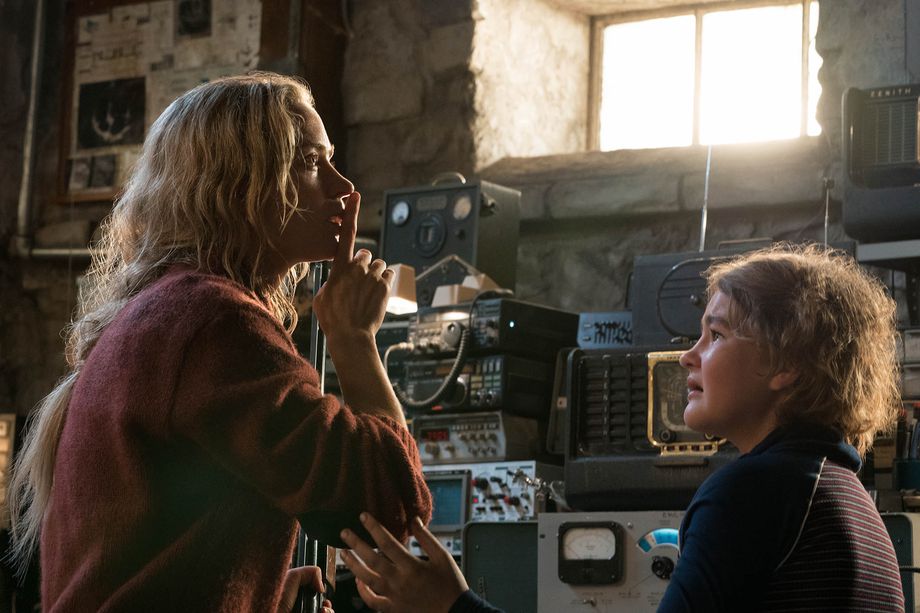
A QUIET PLACE keeps us on tiptoe, listening. Listening. . . for what???

Outside the guarded perimeter of the Abbot Iowa farm house lurk Monstrous Presences. They prowl unseen through the meadow grasses. But we hear their chattering jaws and gnashing teeth. Although these Creatures are blind, the slightest sound from humans brings them instantly to the scene, where they savagely devour their prey. Any sound is fatal. And when the youngest Abbot child accidentally triggers the tinny sound of a toy, they are on him in an instant. And he is gone, without a trace.

Who these Creatures are and how they came here is unknown. Only a handful of newspaper clippings tacked onto the Abbot’s basement bulletin board hint at some sort of invasion that has left the world hostage to sound—any sound, natural or human. Cities and towns, ordinarily a cacophony of sounds, have gone silent. Only the quieter countryside offers refuge. And here are the Abbots, marooned and embattled within their guarded perimeter. Their only advantage is that they can see and the murdering Creatures cannot. So, quietly, voicelessly, the Abbots go about their days and nights, under siege, ever on guard against making the slightest sound. Down in the farm’s basement, Father taps out radio signals in a futile attempt to reach the outside world. He keeps a cache of noisy fireworks out in the field in case their noise is needed to distract the Creatures away from the farm. And a perimeter of lights are color coded—green for safety, red for danger.

Despite the deadly menace of these creatures—soon revealed to be hideous, scaly, arachnoid-like creatures—the focus of the film holds the Abbots in a tight and loving embrace. It is their story, after all. The young children are smart and protective of each other. And when Mom and Dad find a precious moment to embrace in a quiet dance, the moment is a brave defiance of love against encroaching evil. They are survivors. Ironically, however, the love that binds the family together ultimately brings about its own dangers. It is love that impels the father to issue suicidal screams to attract the Creatures away from his young son. The loving embrace of the mother for her newborn baby threatens to attract the Creatures prowling about the farm’s basement. Indeed, the birthing sequence must be counted among the most harrowing moments in this or any film.

It is left to the eldest daughter, whose deafness has taught them to communicate by sign language, to discover a way to ward off the creatures. The high-pitched shriek of her ear-piece shatters the Creatures’ highly-developed, sensitive ear drums, allowing Mom time enough to level a fatal shotgun blast. Until the next invasion. In the film’s final moments, she cocks the rifle and waits.

What makes A QUIET PLACE so effective is a soundtrack that insists on suppressing all sounds. And in doing, it enhances the smallest sounds. Too many standard-issue horror films do the opposite: They pump up the volume. They don’t frighten, they only deafen. There have been a few blessed exceptions: Preceding A QUIET PLACE a few years ago was a film called Don’t Breathe, a symphony of soundless horror. It was about three thieves who were held hostage in a darkened house owned by a murderous blind man whose preternatural aural faculties alerted him to their slightest noise. Much of the action held everyone frozen in position, silently poised a few scant feet from one another, the slightest sound both a protection and a danger to predator and victim alike. Let the Right One In and The Eyes of My Mother are two more recent films that deployed silence to provoke our ghastliest nightmares.

Now, A Quiet Place makes us listen. I must admit, however, that there is one drawback to all this: In the theater, we’re more aware of the popcorn munchers and paper-bag rattlers than ever. And those sounds can be like thunder.

This is the debut dramatic film from director John Krasinski, who also appears in the cast opposite his wife in real life, Emily Blunt.

Monday, April 9, 2018

READY PLAYER ONE: BALANCING ACT


Directed by Steven Spielberg. Based on the novel by Ernest Cline.

After spending almost two and a half hours watching Steven Spielberg’s READY PLAYER ONE, I am left with the final speech, addressed to us viewers: “SPEND MORE TIME IN REALITY! THE ONLY REALITY IS THE REAL!”

Dutifully, I tore off the 3-D glasses and hurried out of the theater, hungering, even lusting, after “The Real.”

Why, I wondered, as I guided my car into the homecoming traffic, did I spend two-and-a-half hours with this movie’s virtual realities—if its ultimate message demands that I deny them?

But then, as I headed homeward on I-435 at 4:00 in the afternoon, I had cause to revise my thoughts: The traffic was in gridlock. Turning onto the off-ramp into my suburban neighborhood, the fast-food signs accumulated rapidly, shouting their own realities of burgers and fries. I repeated the question in growing exasperation: So THIS is the “Real???” . . . And then at home, as I sat down to the keyboard ready to write about READY PLAYER ONE - I was immediately assaulted by the latest rants from Donald Trump: SO THIS IS THE “REAL”???

Neither the REAL nor its VIRTUAL substitute has any validity unless both are balanced; or, to put it another way, citing St. Augustine, fact and fancy, like our perception of the Godhead, are both ONLY A MATTER OF DEGREE, MORE OR LESS.

What READY PLAYER ONE did for me, in the meantime, was provide a lovely extended sequence when we plunged into a virtual reboot of that 1980 classic, THE SHINING. Now we could prowl the interiors of the Overlook Hotel once again, although now we are participants in the action. And I wondered if I could reboot my own version of READY PLAYER ONE to explore other sites of experience and nostalgia, plunging into the cinematic realities of my own childhood. How I would want to immerse myself into my seven-year old experience with Disney’s PETER PAN; only now I would be in it, soaring over the rooftops and towers of London, and alighting, light as a feather on the clock hands of Big Ben.

READY PLAYER ONE also encourages each of us to reboot our own realities, our own nostalgias. Author Ernest Cline had his nostalgic revisit to the 1980s. I suspect, given his druthers, Spielberg might have preferred his own movie reboot, say, to blast off with the crew of ROCKETSHIP X-M, from his childhood, in 1951, on its way to Mars. My grandfather would have looked further back and to revisit THE GLENN MILLER STORY and sit in on the legendary gig at the Glen Island Casino in 1939. And his father would ride with Douglas Fairbanks, Sr., as he and the Musketeers rushed to the aid of the French Queen.

And so forth. . .

Maybe, in a way, our own imaginative illusions are necessary to help cushion the shock of the REAL outside the theater— when, albeit reluctantly, we have no choice but to SPEND MORE TIME IN REALITY!

Monday, December 18, 2017

THE LAST JEDI: FOR GOD’S SAKE DO SOMETHING!


Directed by Rian Johnson. Starring Daisy Ridley as Rey and Mark Hamill and Carrie Fisher as You Know Who.

The last thing anyone needs is my take on the new STAR WARS entry. What follows is just my own selfish need to get a few things off my chest after enduring the damn thing. Yes, enduring what was, for me, a movie which at its core was bland and, well, inert. Forget the plot. I already have. No, I refer to the iconic characters of who exist at center stage, Luke and Leia, whose beloved souls who are no longer with us. Requiescat in pace. Indeed, both are scarcely present in this movie at all. Take Mark Hamil, who spends his time glowering inarticulately beneath the cowl of his monkish robe. C’mon, Mark, say something! Stop galloping up and down the steps of your own little island, running away from Rey, and do something. When you stop for a breath, you can only mutter something about the Stuff that Binds Together the Universe. Lucretius said it better thousands of years ago. And Philip Pullman pronounced it better last week in the His Dark Materials books. Now, I’m the first to admit that at the time of your final face-off, you have a tiny, almost inadvertent great moment, i.e., when after the froth and fury of a deadly fusillade of cannon fire, you remain nonplused, fastidiously flicking an offending bit of grit off your cloak. But that’s about it. Otherwise, you wind up after that only a useless pile of empty clothes.

And take Princess—now General—Leia. Please. Carrie, I’m sad that the script and the filmmakers have given you so little to do. Except merely existing like a useless lump with that hang-dog expression during protracted close-ups of your glum features. I’m not complaining that you’ve grown old—heavens, God help us all!—but you’re Our Princess, and we can reasonably expect more agency from you. And when you exit the planet, comatose from enemy fire, floating up and away. . . I must confess I hoped you would not come back. Why you did come back, considering it would have been a useful exit moment for your character, I have no clue. But because you are back and will presumably return for the next movie, I hope the filmmakers will have the grace not to subject you to CGI immortality but allow you to gracefully fade away into the nether regions of The Force.

Character counts—even in Space Opera. I grew up with John Carter’s interplanetary adventures, and he and Dejah Thoris could teach Leia and Luke a lot: Namely, even if your characters are wafer-thin, you can still do something. In Action Resides Character. Ralph Waldo Emerson said that somewhere. He was a Force in himself.

Saturday, December 2, 2017

ROMAN J. ISRAEL, ESQ.: A HIGHER JUSTICE


Directed by Dan Gilroy. Starring Denzel Washington as Israel, Colin Farrell as George Pierce , and Carmen Ejogo as Maya

“He was drowning in the shallow end of the pool.” What an effective way to describe the plight of Roman J. Israel (Denzel Washington). Once a dedicated, but virtually penniless idealistic lawyer, ever ready to defend the downtrodden in the Los Angeles criminal court system, he turns a corner and sells out for the big bucks. Which means he leaves behind a cramped little office and a lifelong ambition to press forward a huge class action suit, and finds himself in the offices of a slick L.A. high-rise, working for a slick boss (Colin Farrell). Drowning .

What happened? After being mugged, and his fortunes reaching a desperate low, Roman takes advantage of an opportunity to turn in a criminal on the run. It’s an illegal move, but it nets him $100,000 on the sly. New suits, a penthouse apartment, and a new job beckon. But his left turn into corruption immediately threatens his life when the imprisoned criminal’s stooges seek him out in retribution. Shaken out of his momentary illicit endeavors, Roman returns the money, leaves his apartment, and prepares to turn himself in. But not before he’s shot dead on the streets.

A higher justice? It falls short of the kind of redemptive fable Joseph (Lord Jim) might have written, but it delivers Roman back to the ideals of his youth. But a fatal price.

Although the film tries to do too much in a short span of screen time—Roman’s fall-and rise is abrupt and unconvincing. But thanks to Denzel Washington, who fairly lives in the role, the film delivers something rare in movies about the law—a tribute to those who labor on behalf of the ideals of law and order. While it lasts, the film is gripping and flows at a satisfying pace. And there’s Denzel’s performance of a man lost in the early idealistic years when he was mentored by a legendary champion of the downtrodden—a rather pathetic figure who shuffles along in his rumpled clothes, stuttering nervously, constantly adjusting his glasses, cursed by a motor mouth that constantly gets him in trouble. He’s something of a savant, gifted with a phenomenal memory for legal minutiae, but hopelessly out of place in the more cynical halls of justice. Another actor might have delivered nothing more than a collection of outward tics and eccentricities. But for Denzel, it’s a chance to tamp down his powerful charisma and work instead from within.

THE KILLING OF A SACRED DEER


Directed by Yorgos Lanthimos, and starring Colin Farrell as Steven Murphy, Nicole Kidman as Anna Murphy, and Barry Keoghan as Martin.

Do we recall the Greek myth of Iphigenia and the Sacred Deer?

Late in the film we learn that Dr. Steven Murphy’s daughter has written a paper about the Greek character of Iphigenia. This is an important detail, since it echoes the plot of this film: In variants of the Greek myth, by Aeschylus and Euripedes, Agamemnon accidentally kills a deer in the sacred grove of the goddess Artemis; for which he is ordered in atonement to kill his daughter, Iphigenia.

Indeed, Dr. Murphy is faced with a similar dilemma. He is an affluent heart surgeon with a beautiful wife and son and daughter. Lately, he is the target of a relationship with creepy young Martin, a 16-year old whose father had died under Murphy’s knife during an operation. Martin’s attentions, at first affectionate, soon turn dark when he confronts Murphy with an ultimatum: He charges Steven with the murder of his father; and now he, Steven, must kill a member of his own family as an act of atonement. If he fails to do this, his family will suffer from strange maladies—starvation, paralysis, bleeding from the eyes—until they die

Indeed, both children are afflicted and hospitalized. A battery of tests yield no diagnosis. They come home and are confined to their beds, under the care of their parents. Alarmed by their deterioration, Steven kidnaps Martin, ties him up in the basement, and tortures him against the release of his curse (if that is what it is). Anna, meanwhile, learns that her husband had indeed been responsible for the death of Martin’s father: He had been drunk during the operation and the patient had died. Increasingly distraught, Steven threatens to shoot Martin; but the boy only calmly repeats his charge that it is Steven who is the murderer. If Martin dies, Steven will be guilty of the death of his entire family. The choice as to which family member must die is Steven’s. He gathers them all in the basement, places bandages over their mouths, puts hoods over their heads, and stands in the middle of the room, rifle in hand. Placing a hood over his own head, he circles dizzily round and round, firing three times until he blindly makes a hit. It’s the boy, slumped lifeless in his chair.

The film ends with Steven and his wife and daughter sitting at a café table. A few feet away at the counter sits Martin, his wounds healed. After a few moments of silence, Steven and wife and daughter (who now can walk) leave the room.

At first, the tone of the story is very quiet, the pacing deliberate, the dialogue clipped and in a monotone. As the action unfolds and an underlying tension escalates, a strange selection of musical cues embellish the slow-burning action—Schubert’s Stabat Mater, Bach’s St. John Mass, and works by Ligeti and Gubaidulina. The grim deterioration of the children matches the growing disfunction of the Murphy marriage. It makes for gut-wrenching, even excruciating viewing as Steven works out his frustrations in his torture of Martin and moments of violence against his own children.

Notwithstanding all that however, I must admit that somewhere along the way an absurdist quality creeps into the film’s general tone. How easily, inevitably, I think, its unrelenting seriousness verges on self-parody. We are trapped in our bewilderment, unable to decide which is which—not unlike Steven’s own tortuous inability to make his deadly choice.

Friday, December 1, 2017

THREE BILLBOARDS OUTSIDE EBBING, MISSOURI: “JUSTICE WRIT LARGE”


Directed by Martin McDonough and starring Frances McDormand as Mildred Hayes, Woody Harrelson as Sheriff Willoughby, Sam Rockwell as Officer Dixon; and Peter Dinklage as James.

THREE BILLBOARDS is more notable for what it does not do than what it does. Which is to say, it confounds our expectations at every turn, overturning, reversing, leaving them unresolved. Mildred Hayes is frustrated that a year has passed since the brutal rape and murder of her daughter. The case has gone cold. She resolves to plaster three billboards just outside the little town of Ebbing, Missouri with messages accusing Sheriff Willoughby of negligence in the criminal investigation. As bad as his passive reception of the message is, even worse is the reaction of his deputy, Officer Dixon, whose blatant racism offers only obstruction. At length, she learns the identity of a possible suspect. Vigilante style, she packs her gun and leaves on her revenge mission.

At least that’s what the movie at first glance seems to be about. I watched with growing surprise, delight, and even amusement as the plot insists on defying the very expectation it sets up. Let’s sample some of them: (1. When Sheriff Willoughby enters the story, he seems to be a compassionate, albeit rather reluctant agent on her behalf. But his sudden suicide halfway through the film (he suffers from terminal cancer) brings his help to an abrupt end. (2. Deputy Dixon’s racist obstruction shifts suddenly as a result of being burned in a fire—a fire at the police station started by Mildred—and, newly transformed, he launches an independent investigation on her behalf. (3. Mildred’s culpability in that fire is shielded by a local resident, “James,” a dwarf. Immediately, we imagine a growing romance between him and Mildred. But no, she rebuffs him and he disappears. (4. When Officer Dixon overhears what he thinks is an incriminating conversation by a stranger, subsequent DNA evidence reveals his innocence of that crime (although possible culpability of other crimes). (5. Although the suspect is innocent, Mildred and Dixon leave town, armed, determined to kill him anyway, as if in retribution for his other crimes. But in the last scene they admit ambivalence about their mission: Will they kill him, after all?—maybe, maybe not.

In the final analysis, easy expectations are set up, then abandoned. The movie is impatient of standard revenge genres. And it refuses, ultimately, to consign the little Missouri town to cardboard stereotypes. Life itself, in Ebbing and elsewhere—and even sometimes in the movies—has a habit of eluding our easy grasp.

Moreover, spicing this rabidly violent fable are not only quirky comic elements—not the least of which are Mildred’s incendiary actions against anybody who stands in her way (including her son’s teenaged companions)—but unexpected moments of grace. They include the note that Sheriff Willoughby leaves behind to his deputy, assuring him that he sees a “good man” underneath Dixon’s violent bigotry (an insight that soon will be borne out). The help offered Mildred by James is a beautifully nuanced gesture of compassion and an outreach of love. Dixon’s momentary thought of suicide (he holds his rifle to his head) is overturned by his resolve to help Mildred. And, best of all is a tiny scene that fairly shines like a jewel amidst the darkly convulsive violence and brutality of the little town: As Mildred crouches in sad defeat at the base of the billboards, she has a sudden vision of a beautiful deer just a few paces away. The camera remains tight on her face, as she addressed the creature with a wistful monologue about this unexpected intrusion of grace into her grimy life. It’s one of those scenes that illumines the entire film with its wistful beauty. And it surely will show up at Oscar time when her nomination will be accompanied by that very scene.

Friday, November 17, 2017

WONDERSTRUCK: MUSEUM PIECE


Directed by Todd Haynes from the illustrated novel by Brian Selznick. Starring Oakes Fegley as Ben, Millicent Simmonds as young Rose, and Julianne Moore as adult Rose.

With a wonderful title like “Wonderstruck,” with its slew of lightning flashes and power blackouts, space music by David Bowie (“Space Oddity”), a pithy epigram by Oscar Wilde (“We all live in the gutter, but some of us look at the stars”), and a literary property by Brian (the wonderful Hugo) Selznick—with all that, you would think WONDERSTRUCK would dazzle and soar.

Sorry, it’s mostly down-to-earth, burdened with a rambling and leaden pace, protracted dialogue exchanges, and an increasingly tedious pattern of shifts between color and black-and-white. Moreover, it’s a kind of museum piece that walks its characters (and us) through an endless succession of dioramas, curiosity cabinets, and table-top displays. Indeed, the conclusion of the film, which reveals its secrets against the backdrop of an enormous tabletop model of New York City, confirms that its characters and their world are nothing more than a collection of cardboard faces and miniature buildings on display. Welcome to the dollhouse.

WONDERSTRUCK weaves together two narratives. One, set in 1977, introduces us to young Ben, who’s recently lost his mother. He runs away from home and goes to New York City in search of his absent father. The second, set a half century earlier, is about a young girl named Rose. She undergoes a similar quest to New York to find an absent parent, in this case, her mother, who turns out to be a silent-movie star going under the name of “Lillian Mayhew.” The first is in color, the second in black-and-white. The first captures the sleazy chaos of Times Square; the second, the tattered charm of a bygone era.
Figuring prominently in both is New York’s Museum of Natural History, the center of much of the action.

How these stories intersect engages our interest—for awhile. But as these children plod their way through their respective storylines, our engagement flags. And it’s mostly due to that blasted Museum, wherein the children, past and present, ramble interminably through the halls and exhibits. And I mean interminably. Director Tod Haynes seems to be his own museum walker, hypnotized by its clutter of worlds.

And it should be noted that a curious paralysis grips the film when the children, who are deaf, attempt to communicate with scribbled notes and clumsy sign language. These interminable dialogue exchanges bring us full stop, and we watch and wait impatiently for the story to move on. I hate to sound unkind, but really, this is a real problem in narrative pacing. By the time the kids’ quests are resolved and united (young Ben learns that he is the grandson of the little girl from fifty years before), the moment is shrouded in the darkness of a New York blackout. And I, at least, sitting in the darkness of the theater, no longer care to look up at the stars. Unlike the lyrics to Bowie’s “Space Oddity”—heard several times throughout—wherein “Major Tom” successfully travels to the stars, WONDERSTRUCK never gets off the ground.

True, there are wonderful things here. Haynes’ recreations of New York in 1927 and 1977 are amazing in their wealth of authentic detail. In important ways, the black-and-white sequences of the film successfully evoke the experience of watching a silent film. Haynes’s pastiche of Lillian Mayhew’s films (such as Mayhew’s Child of the Storm) is a dead-on parody of virtually anything by Lillian Gish and Mary Pickford). Haynes extends this effect by conveying in a similar manner much of Rose’s story, providing dialogue titles and non-diegetic incidental music. But even here, the pace slackens, relying too much on Carter Burwell’s oddly jarring collection of non-diegetic pop songs and background music. And may I register a personal note: I can’t stand the rock-music version of Strauss’ “Also Sprach Zarathustra” by Deodato, which is heard several times. It’s tacky and cheapens events.

In sum, WONDERSTRUCK is a curiosity cabinet whose many drawers and clutter of figures and objects invites us to pause a moment and enjoy the world en miniature. But after awhile, we are impatient, and ready to move on.

Thursday, November 16, 2017

THE FLORIDA PROJECT: TWO MAGIC KINGDOMS


Directed by and written by Sean Baker and starring Willem Dafoe as Bobby, Bria Vinaite as Halley Brooklynn Prince as Moonee

I emerged from a screening of THE FLORIDA PROJECT confused, disheartened, and angry. I couldn’t shake its disorienting effect. The streets and people outside the theater seemed but an extension of the desperate lives and failed hopes on screen.

That’s the powerful, if disorienting effect this amazing film has on the viewer. It’s a story of two “magic” kingdoms in Orlando Florida. One is Orlando’s Walt Disney World; the other is a nearby slum hotel. They counterpoint each other. The first is a shining Cinderella castle of dreams; the second is its garish parody. Cinderella’s castle is a glorious illusion; the motel is the sordid reality behind that shining curtain. Both lie simmering under the blazing Florida sun.

Among the motel’s collection of drifters, drug dealers, and near-homeless are a mother, Halley (Bria Vinaite) and her six-year old granddaughter Moonee (Brooklynn Prince). Mother and child are running wild, from the very beginning of the film, feral creatures in the grip of some sort of desperately manic energy. While the little girl is all arms and legs playing contact sport with the world, the mother is warily negotiating with it. While the child and her little friends wreak damage against the hotel’s power system, sets a nearby abandoned building on fire, and spits and terrorizes the inhabitants, Mom is soliciting the guests of a nearby resort hotel and turning tricks in her room. Presiding over it all is Bobby (Willem Dafoe) a kind and hard-working motel manager who wages a hopeless battle to maintain some semblance of order amidst the surging chaos of the inhabitants.

The steady stream of images, incidents, and fragments of storyline gradually coalesce into a mosaic of mounting dismay and horror. Violence ensues. Halley nearly kills another motel resident who accuses her of prostitution. Police and social workers arrive to take her away and consign her bewildered child to foster parents. The little girl breaks away. She flees to the door of one of her little friends. The moments captured in closeup as she screams and pounds frantically at the door are among this year’s movies’ most agonizing moments. She and her friend escape the motel and bolt through fields and across busy streets to the nearby Disney Magic Kingdom. Desperately, they thread their way through the parking lot and the crowds of thronging tourists. Ahead looms Cinderella’s Castle. They run and run. And then, abruptly, brutally, the screen goes to black. Not even the magical fantasy of Disney can help them now.

Like Sean Baker’s breakout film from a few years ago, Tangerine, THE FLORIDA PROJECT is so real and so vibrant that it hardly seems to be a movie at all. The children, in particular, seem absolutely themselves, not the fabrications of direction, camera and script. Contrasting Dafoe’s stoic and sturdy manner (one of his very best performances) are the amazing portrayals by newcomers Bria Vinaite and Brooklynn Prince as mother and child. So raw and seething are their roles, I can hardly fathom how they could have been achieved, ironically, by seasoned actors. There’s not a shred of contrivance here, only a raw authenticity that is unschooled and unvarnished.

Both Magic Kingdoms fail their occupants. Both are only a ground zero, a dead end. Cinderella’s Castle is as hollow and useless as its motel counterpart. Viewers of faint heart and cozy fantasies should stay home. Which is a pity, since this is one of the very best movies of the year.