Tuesday, November 27, 2018

SOMETHING WICKED... AGAIN!

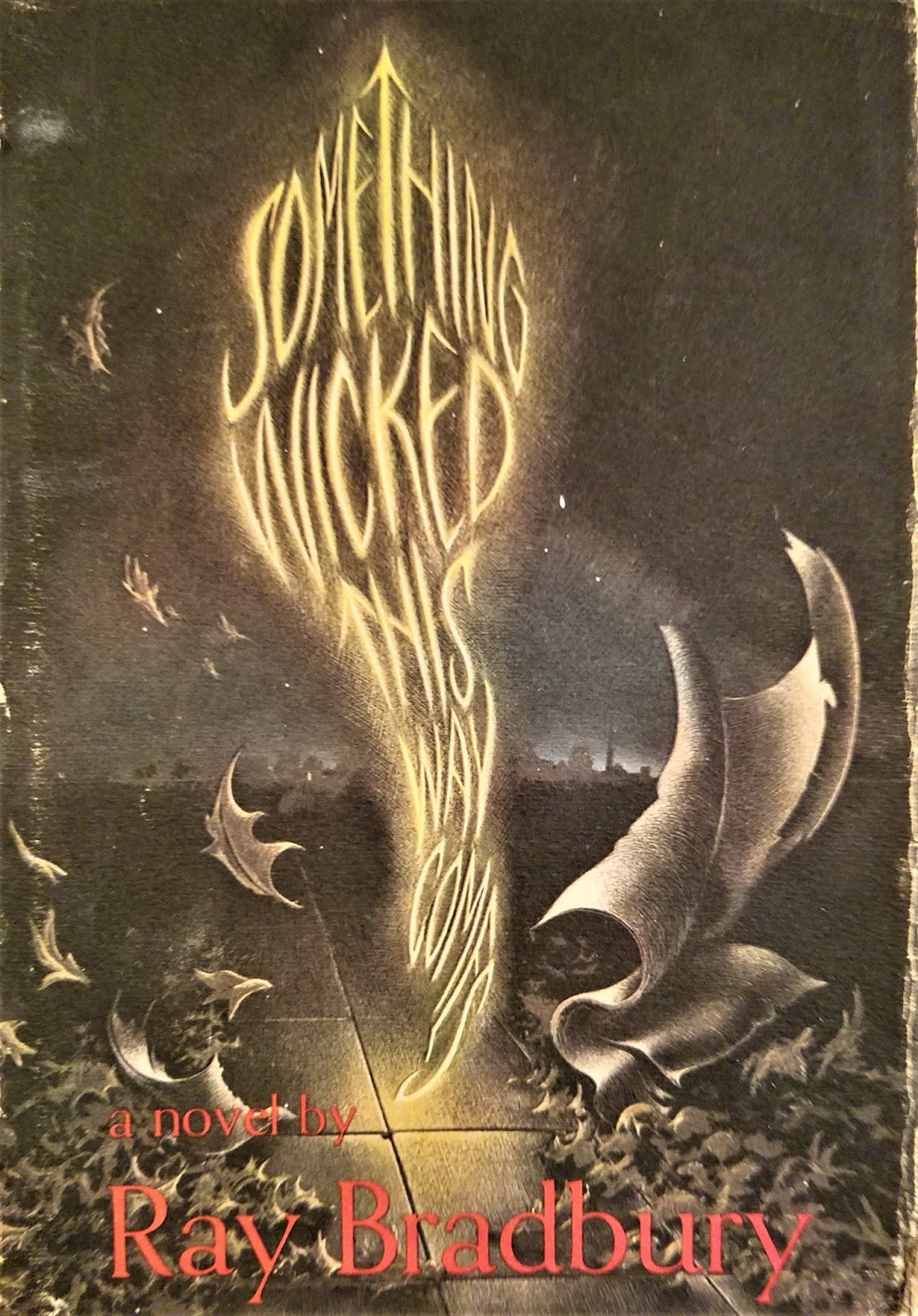
The Good News is that a new edition of SOMETHING WICKED THIS WAY COMES, Ray Bradbury's classic fantasy from 1962, is forthcoming soon from Centipede Press. It will feature three of my interviews with Ray and with his illustrator, Joseph Mugnaini.

This is the cover of the First Edition, artwork by Gray Foy:


And here is the cover of the first British Edition, with Mugnaini's artwork:


Most spectacular was the the poster art from the Walt Disney adaptation, directed by Jack Clayton in 1983. Alas, the movie itself was nowhere as good as this poster art:


I am so looking forward to this new 2019 edition of SOMETHING WICKED, since it brings back memories of my encounters with both Ray and Joe. Here's Joe and me from an interview in the mid-80s in Los Angeles:


Rarely has a partnership between writer and artist been more happily fruitful than that between Bradbury and Mugnaini. They first met in the early 1950s in Los Angeles and remained staunch friends and sympathetic collaborators ever since. Here they are: Mugnaini on the left.


May they both rest in peace,,,

THE HAPPY PRINCE


Written, directed, and starring Rupert Everett as Oscar Wilde; supported by a stellar cast including Emma Watson, Colin Morgan, Tom Wilkinson, and Colin Firth.

“DYING BEYOND HIS MEANS”

THE HAPPY PRINCE is not a happy movie, and it’s not really about a prince. The title comes from a curious fairy tale written by Oscar Wilde in 1888, about a beautiful statue brought down from sublime innocence to sordid reality by the sorrows of the world, leaving behind only an unbroken heart. We flash back to Wilde telling the story to his two sons at times throughout the film. It’s the linking device that binds together the free flow of images past and present.

Viewers relatively unfamiliar with Wilde’s life will not see the parallels between the fairy tale and Wilde’s life during the years after his imprisonment in 1896 for two years at hard labor. Immediately before his conviction and incarceration for the “crime” of homosexuality, Wilde had been a sort of “prince,” the witty and boastful toast of the London stage. His greatest play, The Importance of Being Earnest had lately packed in audiences. But within a matter of months all had come to smash. For two years he suffered greatly as he was passed from prison to prison, barren cell to barren cell, forced to endure gruesome privations that nearly broke him.

A recent book, Oscar Wilde: The Unrepentant Years, by Nicholas Frankel, tells the whole sadly fascinating story of his decline from his release from Reading Gaol in 1897 to his death in Paris in 1900. And now THE HAPPY PRINCE retells events with remarkable fidelity to the historical record, accurately documenting the restless shifts in locations, the struggles for money, even down to the pathetic scene where a priest is called in to conduct a last-minute absolution to Wilde on his deathbed. Which is to say that aside from moments of witty badinage in his best epigrammatic manner, and of boisterous gaiety from the drink-sodden Wilde in the cafes and with his Italian rent-boys, there is little attempt to varnish over events, no false romanticism on display, no sidestepping the spectacle of a man seeming willing his own decline and death. His words, “I run to my ruin,” are all too true. Indeed, one of the chief fascinations of the Wilde story is that very fact—that he seems to have done everything he could to encourage his own downfall. Was there in him what Edgar Allan Poe once described as an “Imp of the Perverse” that impelled him to stage-managing his downfall, as if to imitate the “art” of the fairy tale?

At the same time, the cast of THE HAPPY PRINCE is so skilled and the sheer craft of the movie-making so expert, that the free-flow shifting of events in time and space is deftly executed and, ironically, a pleasure to watch. And as excruciating at times as is the narrative—flashbacks to the privations of his imprisonment, the sordid details of his heavy drinking, his sexual indulgences, and the fatal attraction to Lord Alfred Douglas (the charismatic and heartless youth who played such an important part in Wilde’s life, before and after his incarceration)—the drama remains fascinating and compelling. Now, although Lord Douglas—affectionately called “Bosie” by the besotted Wilde—is here an unalloyed monster, I should note that for some historians Douglas’ role in the whole business has been unfairly impugned.

The jury’s still out on that.

If I must cite a lapse or two in this otherwise faultless narrative, it’s the unwelcome intrusion a couple of time of an excerpt from Tchaikovsky’s “Pathetique” Symphony. The music of this late 19th century Russian homosexual is obviously yanked in to corroborate the pathos of Wilde’s last days. Sorry, it’s just too obvious in a movie that is otherwise canny and subtle in its effects.

Friday, November 16, 2018

CAN YOU EVER FORGIVE ME?


Directed by Marielle Heller, scripted by Nicole Holofcenor, starring Melissa McCarthy as Lee Israel, Richard Grant as Jack Hock, and Dolly Wells as the bookstore owner.

SORDID AND FABULOUS!

Yes—“a pretty sordid and fabulous story” is what the New York Times said about real-life writer Lee Israel’s memoir of her days forging the signatures of celebrities such as Dorothy Parker, Noel Coward, and Marlene Dietrich.

I could say the same thing about the new movie, CAN YOU EVER FORGIVE ME?

Make no mistake about it, this is no cozy collection of beguiling eccentrics plying their fraudulent trade, but a shabby collection of people who feint, dodge, and barter for survival against the grime of the city and the loneliness and desperation of their lives. But at least they live in a New York City in the early 1990s, a poignant, vanished world where you can still find wonderful, independent bookstores and where writers still use pens and typewriters.

Melissa McCarthy’s “Lee Israel” and Richard Grant’s “Jack Hock” are willing, even enthusiastic malefactors. We find her at story’s beginning a down and out writer, an alcoholic with a sick cat, a smelly apartment, many bills to pay, and a readership no longer interested in her biographies of entertainment celebrities like Fanny Brice. (Hey, it’s 1991, years past the popularity of Hello, Dolly! From the late ‘60s.) And Jack Hock is a gay hustler just this side of homelessness, with scars to show from his latest tricks. Together, they form an improbable partnership that provides some of the best moments in this or any movie in recent memory. Granted, we already know Richard Grant as one of our finest dramatic actors. But McCarthy—well, who knew??? Hers is a finely nuanced portrayal of a sadly defiant woman who takes no prisoners.

At first, Lee’s forged letters are a profitable success. It’s one of the nicest ironies here that she can write wittier and more interesting letters by Noel Coward and Dorothy Parker than they could write themselves! Indeed, an even nicer irony is that Lee truly “finds” herself as a creative writer by impersonating other writers! But when autograph collectors get wise and set the Feds on her trail, she enlists Jack Hock to continue their nefarious trade while she stays out of sight.

Inevitably, disaster catches up with both of them. But if you expect Lee to appear before the judge crying real tears, you’re wrong. Her unrepentant speech--and McCarthy’s performance—belongs to the A-list Oscar performances this year. Similarly, Richard Grant’s performance as Jack Hock’s valedictory speech belongs to the ages.

Add CAN YOU EVER FORGIVE ME—the title comes from a Dorothy Parker quote—to the list of outstanding films over the years about forgers. Coming to mind are The Hoax and F Is for Fake, both about Clifford Irving, and Shattered Glass, about the exposure of a series of fraudulent articles in Vanity Fair. We live in strange times, after all, where collectors pay the big bucks for every scrap and scrawl of a celebrity autograph. We know full well many are faked—the sports world is particularly guilty of this sort of thing—but still we want to believe. Indeed, what is it about our own fascination with this sort of thing? Why are we so willing to suspend our disbelief? Why do we enjoy the illusions of stage magicians, knowing all the while we are being fooled? Or, most pertinent of all, why does the votership base of our President unswervingly support him, with his own bag of tricks on full display?

Monday, November 12, 2018

HALLOWEEN


HALLOWEEN, directed by David Gordon Green, and starring Jamie Lee Curtis as Laurie Strode, Haluk Bilginer as Dr. Sartain, Will Patton as Officer Hawkins.

HIDE AND SEEK

You come away from the new HALLOWEEN almost suffocated from two hours confined in safe rooms, crawl spaces, and cages; from two hours hiding and seeking in a dark tangle of Halloween tricks and treats.

Yes, here is another HALLOWEEN, or, more properly, a second take on the original John Carpenter classic from 1978. Improbably for some (including me), that original outing has spawned over the years a host of sequels and a plethora of copy-cat slasher films. Praise it or blame it, it’s a force that has come to be reckoned with.

Now, forty years later, Laurie Strode (Curtis) has turned her encounter with stalker, Michael Myers, into an obsession to kill him, should he ever escape the insane asylum that has housed him all this time. She has amassed an arsenal of weapons (which she proudly displays in a scene evocative of Travis Bickel’s weapons array), rigged her house with a basement saferoom and fitted out the rooms with cages, alarms, and booby-traps. Michael Myers has given her a Purpose in Life.

He has likewise given his psychiatric keeper, Dr. Sartain (Bilginer) a decades-long fascination with his charge that threatens to swamp his own identity to the point that, late in the movie, he actually dons Myer’s face mask in some weird sort of Brotherly Love. Watch him tenderly stroke Myer’s face and then don the mask. That’s the most disturbing scene in a movie that all too often lapses into just another collection of pop-up scares.

Another scene that pulled me out of my almost somnolent state also transpires late. That’s when director David Gordon Green baldly copies the most famous scene from the original film. I refer to the moment when Laurie has pushed Myers out a window onto the street below. When she takes a second look, the body has disappeared. It was a great moment, the instant that a physical horror transitioned to a transcendent evil. The new HALLOWEEN reverses the polarity: This time it’s Laurie who has been pushed by Myers out the window; and this time, it is Laurie who disappears upon a second look.

Now, both Predator and Prey have surpassed their mortal coils and belong to the ages.

At least, that’s about the best I can come up with regarding an only mildly interesting horror film.

Maybe the Final Horror is that David Gordon Green, a director capable of the wonderful George Washington, has come down from the sublime to the ridiculous.

Wednesday, October 31, 2018

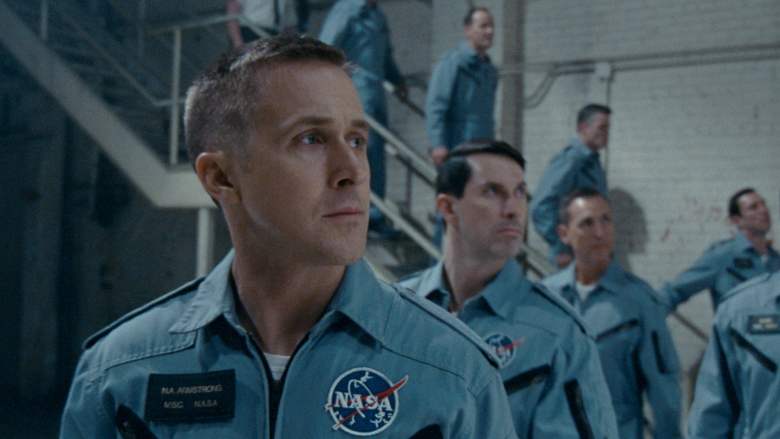
FIRST MAN


Directed by Damien Chazelle, starring Ryan Gosling as Neil Armstrong and Claire Foy as his wife Jan.

A SPACE CASE

FIRST MAN is a big box of visual and aural tricks with which the film manages not to tell its story of the first man on the moon, but to suggest it. It’s almost—but not quite—a ho-hum event. Witness this brief exchange between spaceman Neil Armstrong’s wife and son: She tells the boy his father is going to the moon. The child replies, indifferently, “Can I go outside and play?” Life is like that in this movie: Daddy “goes outside” to the moon; his son “goes outside” to play.

Nice.

Thus, FIRST MAN is an almost offhand treatment of events that will be familiar to those of us alive and aware at the time of Armstrong and Buzz Aldrin’s walk on the moon on July 20, 1969. Newer viewers unaware of the details of the story are likely to spend moments in this movie puzzled and wondering just what is going on. The movie is an evasive maneuver and seems perversely determined to catch those viewers guessing, while parsing out the story in dribs and drabs.

Consider. Notably lacking is the apparatus included in most historical films, i.e., those helpful narrative devices of billboarded titles, a few newspaper headlines, newsreels, and radio broadcasts that contextualize the narrative. Only at the end, as Armstrong’s foot plants itself in the lunar dust, do we get a smattering of same. Instead, for most of the time, snatches of conversations are sometimes muttered, evaded, interrupted—even unintelligible at crucial moments. The characters keep their backs turned to us at times; at others, they are almost lost in the background of a shot. And what they say is, well, more unsaid than said. And the Big Moments of the drama are so downplayed as to be almost repressed. Example: When the final decision is made that Armstrong will be commander of Apollo Eleven, you can almost hear him saying, “Okay, now pass the salt.”

Now, all of this is quite appropriate to the way Armstrong himself comes across to us. At times he’s IN space; at others, he’s rather OUT of it—

Space Case.

Seldom has a visual style and a psychological portrait been so strongly unified as in this portrait of the first man on the moon, Neil Armstrong. We see him sidelong, as it were, from a skewed angle, his words few and his expressions spare. He is remote, diffident, distant from his fellow astronauts, mostly absent from home life. His emotional distance from his long-suffering wife and children is as remote as his distance from the moon. It’s all his wife can do to persuade him to talk things over with his children before the Launch. No matter the chaos around him—be it an unruly child, a test pilot crash, a space capsule emergency, a near-miss of the moon—he is unruffled and remote.

What’s explains the psychic and emotional trauma behind this man? The film gives us an answer—sort of. It begins with the apparent loss of his baby daughter to cancer. At least, I think that’s what happened. The montage of images is so select and so subtle, that we wonder if it happened at all. By the way, the child does appear to him in later scenes. In a way, to him, she never died—

Space Case.

I might add that Ryan Gosling’s performance as Armstrong is perfectly attuned to this sort of measured distance from people and feelings. No one on the planet—or on the moon—can better convey this sort of thing. Remember Lars and the Real Girl?

Sunday, October 14, 2018

BAD TIMES AT THE EL ROYALE


Directed by Drew Goddard, starring Jeff Bridges as the priest, Cynthia Erivo as the singer, Lewis Pullman as the hotel proprietor, Jon Hamm as the FBI agent, Chris Hemsworth as the false prophet, and Dakota Johnson and Cailee Spaeny as the sisters.

A QUIRKY GUEST REGISTER

BAD TIMES AT THE EL ROYALE might be the best thing in the theaters at the moment.

Check in at the most bizarre hotel this side of Barton Fink, where a group of travelers gather for a night of confrontations, revelations, and gruesome violence. And speaking of the Coen Brothers, BAD TIMES is right out of their playbook. It’s a dangerous Neo-Noir set in the late 1960s. It’s a dark and stormy night. Lightning flashes fitfully illuminate the scene. The blood-stained guest register introduces a motley cast of characters. And despite the grim pleasures of it all, there’s a moment of grace that tops it all off at the end.

There’s the priest who’s not a priest but a thief and ex-con looking for buried money under the floorboards of one of the hotel’s rooms; a vacuum salesman who’s an FBI agent keeping the hotel under surveillance; a struggling lounge singer who just wants to get to a gig in Reno; two young ladies on the run from a phony evangelist, and a self-styled hick evangelist who lives by his own infernal playbook. And yes, the hotel proprietor with lots of secrets of his own: He’s left a string of bodies in his wake; moreover, he possesses an incriminating piece of surveillance film. Did I say “surveillance”? The El Royale Hotel is a voyeur’s paradise. A secret corridor of one-way mirrors affords uninvited glimpses into the unholy activities of the occupants within.

The narrative line is a tangle. We view brief vignettes of each of these lives, only to be rudely wrenched out of the scene by savage and abrupt shock cuts. Events are then rewound and repeated by reverse angles viewed through the one-way mirrors. It’s disorienting, but fascinating. Indeed, a certain diabolical pleasure holds us in a kind of thrall as we piece together the shards and fragments of the story.

Of course, it all ends up in a holocaust of flames, bullets, and bodies. Everything gets sorted out... sort of. But amid the penultimate moments, when the priest who’s not a priest hears a last-gasp confession and delivers his own absolution, we are moved by an experience that is nothing less than an epiphany.

So many things could gone wrong here; the kaleidoscopic assortment of characters and fractured incidents could have fallen apart at any moment.... However, the conviction and power of all these players keep things under control. In particular, Jeff Bridges and Cynthia Erivo deliver beautifully crafted performances. Bridges’ faux confession scene is among his very finest moments on screen. Erivo’s quietly nuanced a capella singing provides the soul of the story. Indeed, I came away, wondering, who is this Cynthia Erivo? I had not seen or heard her before. But her quietly desperate lounge singer is a miracle of subtlety. On both counts we have here Oscar-caliber moments. (Note: Erivo is a British actress and singer recently distinguished for her Tony Award-winning performance on Broadway of “Celie” in The Color Purple.)

In brief, this is a movie for the jaundiced eye.

Tuesday, October 2, 2018

THE WIFE


Directed by Bjorn Runge, starring Glenn Close and Jonathan Pryce as Joan and Joe Castlemans and Christian Slater as the journalist.

GHOST WRITERS IN THE SKY!

In THE WIFE, veteran actors Glenn Close and Jonathan Pryce have been ill-served by a lame and improbable script. Too bad. It should have been fun to see these two pros on screen. What results, however, is mostly a pompous, strutting Pryce and a showcase for the Glenn Close Enigmatic Stare.

Dramas about writers and writing are notoriously difficult to bring across. There are exceptions, notably Jane Campion’s Angel at My Table, about Janet Frame, and End of the Tour, about David Foster Wallace. And recently we have had Genius, about the relationship between Thomas Wolfe and editor Maxwell Perkins—whose subject of an editorial hand behind the writer’s success rather resembles THE WIFE.

But THE WIFE doesn’t belong in that accompany.

After more than thirty years spent ghostwriting her husband’s books, Joan Castleman watches in dismay as her husband Joe thanks her during the ceremony in Stockholm for being his muse and support. Disgusted, she leaves and threatens divorce. She would rather live in anonymity than be credited merely as his helpmate. But she is more than that. She wrote his books in secret, all of them, behind a closed door, the family unaware of what was going on. All this time, her husband’s main job has been to stay out of her way. Check that: He does do something: He cracks walnuts a lot. I kid you not. He not only cracks them for her, but he cracks them for all his mistresses, too. That’s a lot of walnuts. And a lot of mistresses. Even the title of one of his books is The Walnut. Really. I expected a “walnut wrangler” on the end credits. How he’s been able to disguise the fact that he hasn’t been writing at all is never explained. Maybe the walnut-cracking was enough to fill his spare time. The closest he gets to literature is to quote James Joyce to any young lady who catches his eye. Have a walnut?

Poor Joan Castleman. Is she another downtrodden female writer? Not a bit of it. She’s not only content to be his ghostwriter, but flashbacks reveal that she had wanted to write his books. It was her idea from the get-go. He thinks he is seducing her; but in reality it is she who has been seducing him, catering to his ambitions for the success, fame, and privilege of a successful writer. She is no victim. This is her choice. Who is guiltier of hoaxing the public, he or she? As for that celebrated Glenn Close Enigmatic Smile, is this the expression of a wronged wife or a crafty manipulator? And yet, at the end, we’re supposed to believe that she has HATED this all along. Please.

I realize this is probably a subversive reading that I’m offering here, one that is completely counter to the movie’s putative commentary on The Wronged Woman. . . but that’s my take and I’m sticking to it.

Meanwhile, what about the Castleman books? What do we know about them? Why the Nobel Prize? According to the speech at the Nobel ceremony, Castleman’s books have “changed the course of literature.” Whatever that means. Too bad such superlatives don’t describe this script.

We can’t forget another character who shows up at the proceedings. He’s a trash journalist, a ruthless opportunist who wants to write the tell-all expose of the Castleman’s chicanery. Christian Slater is perfectly cast and perfectly hateful. He’s right where he belongs. He and the Castlemans deserve each other. His dialogues with Mrs. Castleman demonstrate only that she’s a greater fake than he is.

Lastly, there is one more tag-along character in this wearisome parade. And that is Castleman’s son, a budding writer, God help him. He wears a perpetually surly expression and wrings his hands because Daddy won’t praise his own pitiful stories. Does he know that the best example Daddy can provide him is how to find a beautiful graduate student who will do the writing for him? As for the nut-cracking, he is on his own.