Monday, December 14, 2015

CHRISTMAS, DICKENS, AND EVERETT SHINN


For me the benchmarks of the Christmas season include the Robert Shaw Chorale’s immortal performances of the sprightly “Patapan” and the deeply moving “Coventry Carol.”


And in painting and literature, Christmas will always be the union of painting and literature in Everett Shinn’s illustrations of Charles Dickens. I am fortunate in possessing several of these illustrated editions. And who was Everett Shinn (1876-1953)? He is probably best known in art history circles as one of the many so-called “Ash-Can,” or “Street” painters working in America at the turn of last century. There are reasons for selecting Everett Shinn as the most representative painter of this august company of new realists. He was the first of these painters to take to the New York streets; he was, with John Sloan, the finest street painter of the day in the eyes of certain contemporary critics; and he worked with some of these other names in the service of the new realism--Theodore Dreiser, William Dean Howells, Clyde Fitch, and David Belasco.


Shinn had come to the Pennsylvania Academy of the Fine Arts in 1893, the year of Crane's Maggie and Stieglitz' early New York scenes. There he first met his companions of the later "Black Gang" years, John Sloan, Robert Henri, and George Luks. They all begin working on various newspapers in Philadelphia where they quickly acquired the facility to cover and illustrate news stories. By 1897 Shinn was in New York, the first of the ash can artists to go there. He translated his street experiences into a series of paintings, pastels, and drawings for the New York World and magazines like Harper's Weekly. 


Everett Shinn

I don’t know why Shinn’s Christmas illustrations are completely ignored in the only biography extant about him, Everett Shinn: A Figure In His Time, by Edith De Shazo, but it’s a colossal sin of omission. Shinn’s Christmas books are real collector’s items. In particular, his illustrated Dickens titles. From A Christmas Carol are dozens of paintings and line drawings. 


Shinn’s sense of the exuberance of pre-Victorian London is amazing!


And here’s Scrooge and Edwin Drood:


You can almost feel the spookiness of this scene of Scrooge encountering the “Ghost of Christmas Yet to Come.”


But oh! Those pen-and-drawings! Shinn was as much a virtuoso of the line as Dickens was of his lines! This is a page from Cricket on the Hearth.


Since childhood I’ve warmed myself at the hearth of these books. Seldom has a writer been so well-served by an artist as Dickens has been served by Everett Shinn!

"Charles Dickens in the mid-1830s," drawing by John C. Tibbetts

Sunday, December 13, 2015

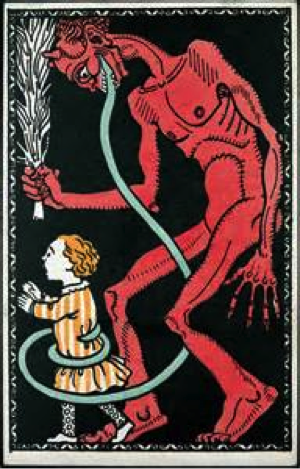
KRAMPUS! ANTI-CLAUS

KRAMPUS! ANTI-CLAUS
Directed by Mike Dougherty


What BAD SANTA did to Santa Claus, KRAMPUS does to Christmas in general. Although Krampus’ visits are traditionally on December 5, as far as this movie is concerned, it’s a Christmas Eve story. Which is fine, since we all know Christmas Eve is the best time for ghost and horror stories. Isn’t it?

This is a very, very wicked little parable, boys and girls, about what happens if you disbelieve in Christmas, or if you tear up your letter to Santa Claus. That’s what a little boy named Max does at the beginning of this film. Out the window goes the torn pieces. Into the house comes the Nightmare. And what had already seemed to Max as a very nasty Christmas Eve—what with the horrid relatives gathering and all that—turns really, REALLY bad. He hadn’t counted on the old Swiss folklore tale dating back to the 1600s of Krampus, the malevolent punisher of Those Who Disbelieve. Parenthetically, I already knew about KNECHT REPRECHT, who comes at Christmas to punish bad children, but this guy KRAMPUS, is a new one on me.


You can find out all about this tradition in the new issue of Rue Morgue (December 2015), one of the better zines out there devoted to the weird and the fantastic. Seems like the roots of the Krampus story are certainly –pre-Christian. The beast’s name is taken from the German word for claw (“Krampen”), who is said to be the son of Hel, a partially rotted Norse god who rules the Land of the Dead. Krampus’s beating stick is considered to be a pagan symbol symbol associated with witches. And perhaps the creature’s chains represent Christianity’s unsuccessful attempts to restrict and bind it.

So be it. As the boy watches in growing horror, the wind stirs up, the blizzard falls, the house’s power shuts off, and a gang of very strange Snowmen gathers outside. Inside, all the charming little Christmas toys—a jack-in-the-box, gingerbread men, other assorted cookies, tree ornaments, elves, clowns, etc.—all swell and enlarge and grow big teeth and fiery eyes and mount their attack. Worse, there’s Krampus himself, a yowling, throaty, horned-lump of a beast dragging lots of chains, who appears to preside over the deadly merriment.


One by one, the family members are picked off. Some are gobbled up. Some are hauled up the chimney on a big hook (hey, its not what comes DOWN the chimney, it’s what goes UP!). Some are dragged down into the snow by some creature burrowing under the snow, like a gigantic moie.


SPOILER ALERT. But the best is yet to come (depending on how you look at it!). After everybody is knocked off, and the boy falls to final defeat at the talons and jaws of Krampus—the boy wakes up. Whoops! I thought, we know that Scrooge woke up after his bad dream; that Jimmy Stewart woke up after his nightmare. . . but do we have to go through this again?? But hang on. The kid comes downstairs to find, to his relief, everything is back to normal—the family is restored, smiling, exchanging gifts, and eating the damned cookies. But when Max opens a small box given him by his German grandma, he finds an ornament with the name “Krampus” inscribed on it. The moment freezes. The smiles on everyone’s faces stiffen. The boy realizes Something Is Very Wrong. The camera pulls back, enlarges our view, withdraws through the windows, tracks backward through the snowy wastes. . . until we find ourselves in a gigantic sort of workshop, Krampus’ Workshop, where Christmas baubles are stacked on shelf after shelf, each globe trapping a family inside, each family just like Max’s. 


Yes, the movie snatches Wicked Defeat from the jaws of Sentimental Christmas.

SLAY -bells, anyone?

Thursday, December 3, 2015

PIANO MAN!

When world-class concert pianist Bezhod Abduraimov returns to his home base in Kansas City for a concert, it’s a “must” event...


And sure enough, his recital of Schubert Impromptus, a Liszt Mephisto Waltz and the Moussorgsky Pictures at an Exhibition on 1 December 2015 was a dazzling, roaring affair. Truly, I have devoted most of my life to cultivating, listening, studying, researching, and enjoying many of the great pianists of our time... and I can tell you that Bezhod, at the tender age of 24 is, to put it bluntly, the Real Thing.

Post-concert autographs
Bezhod Abduraimov is the star pupil of Stanislav Ioudenitch, co-winner of the 2001 Van Cliburn Gold Medalist . Bezhod, as we affectionately call him in these parts, won the Grand Prize at the 2009 London International Piano Competition at the Royal Festival Hall with a performance of Prokofiev’s Third Piano Concerto. The voting was unanimous. He is currently affiliated with the International Center for Music at Park University, Kansas City, MO and records for Decca Records. Critic Michael White has written:
“A year on [from the London International] he’s matured in both appearance and performance into a power-player who projects big sound with big gestures but without the vulgarity or self-indulgence of some young pianists I can think of on the power circuit. For all the drama, aural spectacle and electricity in his playing, it’s substantial, disciplined, and accurate. He doesn’t splash, he doesn’t fake. It’s real.”


He is a native of Uzbekistan, a landlocked country in the heart of central Asia. “It used to be part of the Soviet Union,” explains mentor Stanislav Ioudenitch, “one of the fifteen republics. It borders Kazakstan, Kyrgyzstan, Tajikistan to the east; and to the south by Afghanistan and Turkmenistan. Bezhod was from Tashkent, a large city. His teacher was Tamara Popovich. She was one of the most renowned teachers for young players. Alexei Sultanov, who is another Cliburn Gold Medalist, was also there.”

Bezhod and his sister
I have had the privilege of knowing this young man for almost ten years. Back then, in his mid-teens, he was so shy he could hardly make his way out to the platform. Now, seasoned and fully assured, he is absolutely fearless, blazing through Lisztian fireworks and tenderly nuancing the subtlest of Schubertian “heavenly lengths”—The phrase is Schumann’s—with an almost terrifying calm. But above all, he may be developing into one of the greatest Liszt pianists of our time.


The world is his stage, now... but Bezhod will always be one of ours!