Thursday, May 14, 2015

CRY HAVOC! “MAD MAX!”


Tom Hardy in MAD MAX FURY ROAD

“HOW THE HELL DID HE DO THAT?” is my first response to MAD MAX: FURY ROAD. “HE” refers not to the redoubtable Max but to veteran Australian filmmaker George Miller, who started the whole saga of Max Rockatansky back in the late 1970s. And “HE” also refers to ace cameraman John Seale, who began his career with other Aussies, notably Peter Weir, and is not only FURY ROAD’s cinematographer but the camera operator as well.

Together, Miller and Seale have wrought a masterpiece of aeronautical engineering. FURY ROAD may be a stunt, but it’s an airborne stunt that fills the screen with flying trucks, plummeting oil tankers, leaping motorcycles, and, of course, Max himself.

George Miller in 1982

It may be more than thirty years since Miller decided to put away his physician’s stethoscope and strap cameras to fast cars (see the photo above), but the man, on the evidence of this film hasn’t faltered his stride. Indeed, he’s grown wings.

While some critics are trashing the film and others are offering their own hosannahs, let’s talk about George Miller. I interviewed Miller several times back in the day when MAD MAX, THE ROAD WARRIOR, and MAD MAX BEYOND THUNDERDOME first hit the accelerator. Those interviews now appear in my forthcoming book, Those Who Made It: Speaking with the Legends of Hollywood (original title: Hollywood Speaks!) Here are some excerpts from Miller’s rather droll take on the havoc he has unleashed:
GEORGE MILLER: I came to the film industry pretty late. I was a medical graduate and working as a resident in a hospital when my brother and I won a film competition, and we went to a workshop at Melbourne University. That was in 1970. I always had been a film buff, and when I met Byron Kennedy there, I started dividing my time working in a hospital and experimenting on film with him. We both literally slept, ate, and thought movies. Nothing else mattered. Byron and I made a short satire called Violence in the Cinema, Part I. We showed it at the Sydney Film Festival and it was picked up for distribution. I didn’t even know what “distribution” meant! I think the best thing about having done medicine was that it kept me away from making films for so long. I had time to mature, to see the world. As a doctor I was accustomed to seeing patients in fairly extreme states. I had to grapple with that and confront things I would not otherwise have done.
Miller was quick to downplay his ambitions. Just remember that this is also the man who went on to make the sublime LORENZO’S OIL and the daffy BABE: PIG IN THE CITY:
I have never been a “highbrow” kind of person. I have always preferred pop arts, comic books, that sort of thing. And so I have always loved chase films—like those classic films with Buster Keaton and Harold Lloyd. I think they’re pure visual language. Keaton, particularly, understood the syntax of film so well. And car-crash culture has always fascinated me. Where I worked in the hospital, I had my own morbid fascination with what I call “autocide”—deaths on the highways from car crashes. I’d see so many young people killed, or maimed for life, on the roads.


Mel Gibson in 1982.  Original title:  MAD MAX II

Me and the original "Mad Max," Mel Gibson, taken in 1985
Like other Australian filmmakers emerging in the late 1970s, notably Peter Weir, Bruce Beresford, Fred Schepisi, and Gillian Armstrong, Miller was a student of the American western. However—
Instead of guns and swordfights of American and Samuarai movies, we use the car chases as rituals of death. Personally, I can’t stand slow films. I actually think our first Mad Max was too slow! Now, Road Warrior feels violent, but if you really look at it frame by frame, there’s only the ambiance of violence. Byron and I have studied lots of stunt and chase movies. We’d put them on the editing bench and realize that the cars didn’t really do all that much—it was done through cuts and speeding up bits of film and slowing them down and intercutting them with cutaways to a screaming face, or something. You won’t actually see many frames of explicit violence. But what I hope is that Mad Max II has the kind of kinetic push that doesn’t give you much time to rest. Chases are among the purest forms of cinema.
The American troubadour poet and film critic, Vachel Lindsay proclaimed as much back in his 1915 treatise, The Art of the Moving Picture. George Miller is his latter-day heir.
I want people to come out of the movie feeling like they’ve been on a roller-coaster ride. I feel good when I come out of movie exhausted! And I love to move the camera!

Tuesday, May 5, 2015

“SEEING” VERMEER WITH PROFESSOR BRYAN JAY WOLF


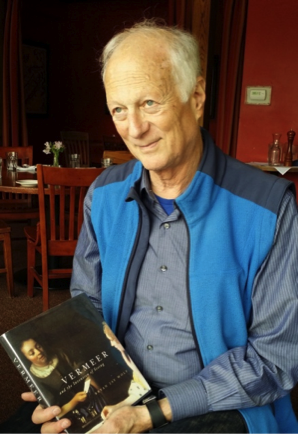
I’ve just spent an agreeable, if challenging, discussion about the Dutch painter, Johannes Vermeer (1632-1675), with Professor Bryan Jay Wolf, whose academic affiliations include Yale and Stanford Universities. His book, Vermeer and the Invention of Seeing is essential reading for enthusiasts and scholars of Vermeer, and even to those who come to the painter by way of a recent series of motion pictures, including GIRL WITH THE PEARL EARRING and the amazing documentary, TIM’S VERMEER.


You cannot fail to be struck by Bryan’s opening words, a shot across our bow: “I take it as my task in this book, and as a task of criticism in general, to name what has gone unnamed in the construction of the work of art... that which the painting will not deliberately display..."


Be not deceived by Bryan’s rather bemused expression (see above). Once into the book, he is all business; and that business is to stand before what he describes as Vermeer’s “silences” and “strangeness.” Both a textual “reader” and an authoritative contextualist, he places Vermeer’s domestic images within what he calls post-Renaissance’s “discovery of the individual self” and reads the texts against the grain, setting “intended meanings against unintended ones.” Vermeer’s paintings “can’t stop talking,” he warns, “and they are not always, on the surface, at least, truthful.” At which point Bryan offers one of the best definitions of art I’ve ever encountered: “What is art if not a lump of history, uttered with precision, from the situated position of an author... a pointed and often polemic curse or blessing from within that history.”


17th-century Dutch painting, in general, was a “retinally-based way of seeing.” Painters like De Hooch, De Keyser, Steen, and Vermeer painted what they saw, pledging fidelity to the a world optically known , which differed from that prescribed by Italian art theory. Their paintings were “an activity of surfaces,” of everyday experiences transpiring outside the artist’s study, yet seen through a mediating lens, or window.

Yet, intriguingly, Bryan insists that Vermeer “problematizes” these domestic activities. His subjects may stay indoors, but they seek to know the world. What is really certain about these images; what do we really know? The women here possess secrets, “they dare not reveal.” Perspectives, architectural details, props elude our expectations; a suddenly turned head, an enigmatic anecdotal detail, an unexpected breaking of the fourth wall--all spin us off our accustomed orbit into “a disquietingly erotic space...”
 

Professor Wolf wears his erudition lightly. There is nothing of the stuffy academic about him. That open, amiable, and engaging gaze (see the photo below) is what he and his love of his subject is all about. Moreover, he stoutly defends the viewer’s own authority. He invites us to follow his example and “read” these images for ourselves, privileging our own hermeneutics while respecting the circumstances lying behind those images. At the same time, he launches us off into a great adventure in reading, seeing, and thinking. We emerge from these pages, refreshed, speculating, even wondering...

Sunday, April 26, 2015

GALLIPOLI MOVIES


THE WATER DIVINER and GALLIPOLI


THE WATER DIVINER is only the third major Australian film of modern times that I know of which is concerned with the Gallipoli Campaign, the Allies’s disastrous attempt to wrest control of the Dardenelles from the Turks in the spring and summer of 1915. Like Ken Hannam’s BREAK OF DAY (1976), but unlike Peter Weir’s GALLIPOLI (1981), Russell Crowe’s directorial debut is more concerned with the aftermath of Gallipoli rather than the battle itself (save a handful of graphically visceral flashbacks).

John C. Tibbetts drawing of Russell Crowe, autographed in1997
 
Crowe begins and ends his film in two water rituals. In the first, he emerges from a newly-discovered underground spring in a scene symbolizing a kind of birth, in this case a determination to locate the remains of his three sons on the battlefield and return them to the “hallowed ground” of his Australian ranch; in the second, he descends into an underground waterway that carries him to safety from the strife that continues after the war to engulf Greek and Turkish soldiers during the partitioning of the Ottoman Empire.

In between are a series of improbable adventures that results in his discovery that a third son is indeed still alive. Yes, improbable. Crowe isn’t very adept at juggling an action adventure with an otherwise contemplative memorialization of a battlefield tragedy that saw hundreds of thousands of losses on both Allied and Turkish sides.

But at its best, we have Crowe’s understated performance and his scenes with the Turkish major (Yilmaz Erdogan), who once was his enemy and is now his comrade in arms.

As I watched, I couldn’t help but recall Peter Weir’s film, which rightly emphasizes the tragic and wholly unnecessary sacrifice of thousands of Australian and New Zealand soldiers (the Anzacs) in a doomed climactic charge in April 1915.

Permit me to cite my book, PETER WEIR: INTERVIEWS (2014), which contains, in addition to interviews with Weir about GALLIPOLI, the full text of a moving speech he gave on Anzac Day on 26 April 2001 in Washington, D.C. (Quoted with Weir’s permission)
Peter Weir and John C. Tibbetts,  Sydney, Australia, 2013
 
In that speech Weir quoted from his diary entry about his first visit to the Gallipoli battlefield::

“Out to dry off in the sun and faint breeze [he wrote], then, hiding my coat, book, etc., under some bushes I set out, feeling great, to walk up Shrapnel Gully. I’ll never forget the two-hour walk. The eerie stillness; felt ghosts all about me. Found water bottles, shells, French tin hors de Concourse 1900. Eno’s Fruit Salts bottle, thousands of shards of broken stoneware “made in Tamworth,” and piles of tins. Ridges towered above me. “Yea, though I walk through the Valley of the Shadow of Death” occurred to me. Back to the beach, exhausted, flop into the sea. Drive to Quinns Post and the N.Z. memorial at Chunuk Bair. Felt very emotional then, and later that night at the hotel.”

Having begun to immerse himself in the sites, historical circumstances, and consequences of the Gallipoli campaign, Weir realized he had to make his film, GALLIPOLI:

“It’s curious how you can know a thing happened. I mean, know it intellectually . . But how much different that other “knowing” is. To see and to touch—to feel it as a truth.”

Trench warfare in Peter Weir’s Gallipoli
Four years after that first visit, GALLIPOLI ended with a memorable charge by the Australian 10th Regiment in the face of murderous Turkish fire. In a deeply ironic, way, that sequence duplicated the footrace that began the film, but with tragic consequences:

“Among the West Australians every man assumed that death was certain, and each in the secret places of his mind debated how he should go to it. Many seemed to have determined that they would run as swiftly as possible, since that course was the simplest and most honourable...  Mate having said goodbye to mate, the third line took up its position... It was about 4:45 a.m... With that regiment went the flower of the youth of Western Australia, sons of the old pioneering families, youngsters—in some cases two and three from the same home—who had flocked to Perth at the outbreak of war with their own horses and saddler—men known and popular, the best-loved leaders in sport and work in the West, then rushed straight to their deaths. Gresley Harper and Wilfred, his younger brother, the latter of whom was last seen running forward like a schoolboy in a foot race...”

Archie’s fatal charge in Gallipoli
Critical brickbats thrown at this new Gallipoli film, THE WATER DIVINER, notwithstanding, Russell Crowe’s debut as a director marks him as a sensitive artist whose only fault, in my opinion, was in perhaps trying to do too much in a film that needed a tighter structural and thematic cohesion.

Friday, April 24, 2015

EX MACHINA


Subtitled EX MACHINA, Alex Garland’s new movie, “R.U.R. (IF YOU THINK YOU ARE”). Forgive the play on words combining the title of Karel Capek’s 1920 play (see below) and the title of a play by Luigi Pirandello. In all these cases, how we define what is human is at issue. In the latter instance, the results are highly ironic.


EX MACHINA tells the story of a computer coder, Caleb (Domhnall Gleeson), who spends a week at the mountain home of Nathan (Oscar Isaac), a brilliant scientist who is seeking the “next step” in artificial intelligence. Caleb will observe Nathan’s newest “experiment,” a sleek, beautiful, and wholly lifelike android/robot called “Ava” (Alicia Vikander) and determine if “she” represents a breakthrough in the creation of a truly “human” creature. If Ava “fails” her test, Nathan will deprogram her and begin anew with a more advanced prototype. Indeed, we eventually learn that he has already created—and discarded—a closetful of female prototypes. Will Ava be next?

During the course of the week, Caleb and Ava both confess an erotic attraction for each other. Ava, moreover, reveals her desire to break out of her hermetically sealed chamber and venture into the “real” world. Caleb contrives to help her escape. But Ava, who apparently has been devising a survival plan of her own, kills her creator, locks Caleb in the lab, and escapes into the outer world. She is last seen, reveling in the chaotic interplay of a crowded street.

EX MACHINA is a intelligent, albeit dizzying collection of gothic tropes, including the experiments in artificial/enhanced life by Mad Scientists Victor Frankenstein and Dr. Moreau, the fatal hubris of the Sorceror’s Apprentice, the erotic terrors of Bluebeard’s Cabinet, the duality of human nature, and many, many more. Here, unlike the Capek play, in which a robotic Adam and Eve start a new life in a world now wholly devoid of humans, it is the female, Ava, acting alone, who will presumably replace humankind with new robotic life forms.

A whole new meaning to Girl Power?

Ironically—and dare I suggest there is a sexist twinge to this—the movie demonstrates that it is in Ava’s devious exploitation of her “feminine” wiles that she is finally able to prove she is truly human.

What was more interesting for me were EX MACHINA’s wittily subtle contrasts and interfaces of human and mechanical intelligence: For example, the lyric murmurs of Schubert’s B-flat Piano Sonata are piped through the empty, sterile confines of Nathan’s home. Outside those neutral-gray rooms gushes a spectacular waterfall and granitic cliffs. And on Nathan’s otherwise empty wall space is a large canvas by Jackson Pollock. “Pollock could not have painted that,” says Nathan, “if he had calculated in advance each brush strike and dribble of paint.” In other words, the “human element” resides not so much in calculation but in randomness, accidents, and unpredictability.


Maybe, inadvertently, Nathan has unleashed his own version of a Pollock painting. His calculated experimentation notwithstanding, Ava will prove to be truly human only when she betrays and kills those around her. Survival is everything.

To be human is pretty risky business.

Sunday, April 19, 2015

MASTER PIANO CLASSES: SEYMOUR BERNSTEIN AND CLAUDE FRANK

My recent viewing of SEYMOUR: AN INTRODUCTION, the new film documentary by Ethan Hawke, has struck all manner of resonances within me about two great pianists, the titular Mr. Bernstein, and the late Claude Frank (1925-2014), pictured below with me at the University of Kansas.


Hawke’s informal portrait of the noted concert pianist/ educator Seymour Bernstein touches a lot of bases (or, piano keys!), namely the biography of a New York-born artist who grew up a keyboard prodigy, survived service in Korea, studied with the eminent British pianist Clifford Curzon, garnered world fame on the concert platform, and has spent his later years teaching the craft and philosophy of art and music.

There’s plenty of piano music, of course, mostly performed by Bernstein himself, with fascinating sidelights on other pianists, notably the eccentric Canadian pianist Glenn Gould, insights into the great piano composers (notably, a passionate commentary on Robert Schumann’s great C-major Fantasie), a tour of the legendary Steinway basement during a piano selection, and peeks into his work with students in master classes.

Ah, yes, the master class. . . Bernstein adopts a warm, patient, and magisterial approach to his students, unlike other master classes I have attended, where somebody like Menahem Pressler is nothing short of ferociously impatient with his students. That is appreciated. But watching these sequences brought to mind my friendship with the late pianist Claude Frank (my drawing below).


I first met Claude when he visited the University of Kansas in 1983 in the first of several Artist-in-Residence appearances there. Instantly, the old-world charm and wit of this master pianist—student of Artur Schnabel and master of the German school of Schubert and Beethoven and Schumann—appealed to me and everyone he met at the University. He sat down with me at the keyboard and talked about his early years in Nuremberg, his escape to America before the onset of World War II, his experiences in the American Army, his subsequent concert career, and his ground-breaking recordings and performances of the complete Beethoven Sonata Cycle. His passion for music and life infused his every word, while he generously punctuated his remarks with performance excerpts. That led to our many other encounters. He became a vital resource for my Public Radio series, The World of Robert Schumann; and just recently, I produced a radio program that featured his affectionate tribute to music in the movies, in particular, his one-man platform performance that mildly satirized the Schumann biopic, SONG OF LOVE (1947). He had allowed me to tape that performance fifteen years ago, and hearing it again now brings tears to my eyes.


Claude Frank and his wife Lillian Kallir (my drawing pictured here), also a world-class pianist, frequently performed together. I vividly remember hearing them both perform a Mozart two-piano concerto. And their daughter, Pamela, has become in her own right a celebrated violinist. Here, indeed, was a family that made beautiful music together. Pamela survives both parents, and a recent performance with Emanuel Ax consolidates her position as one of the pre-eminent violinists in the world.


Master classes. . . nay, MASTER MUSICIANS both, Seymour Bernstein and Claude Frank. I never met the former, alas, but my memories of the incredible generosity and engaging humor of the second, remain a special “musical tone” in my memory.

And kudos to Pamela Frank, whose career carries on the Frank legacy.